By Bret Easton Ellis
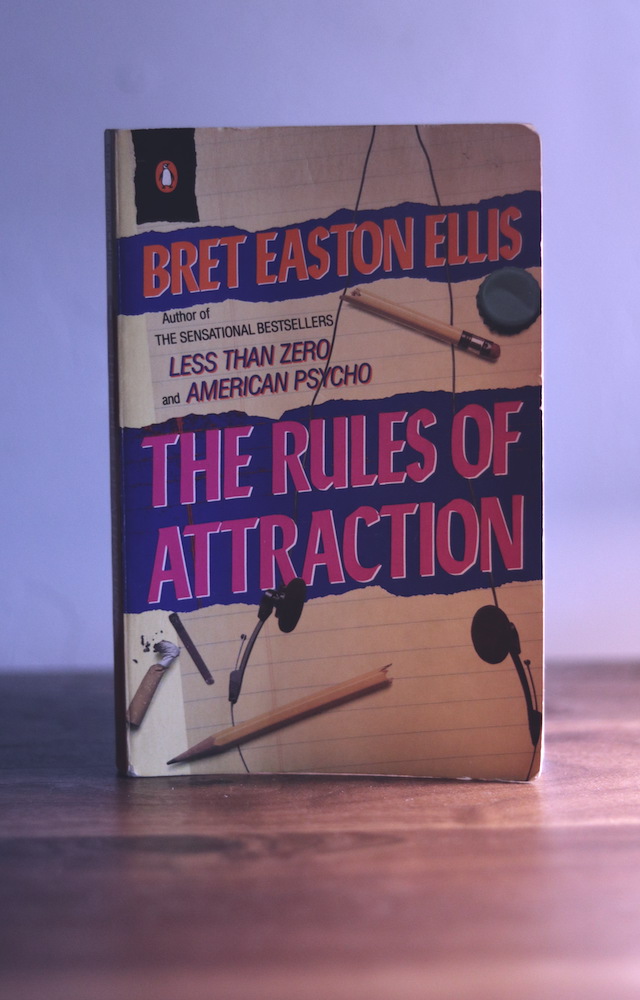
“The rich, privileged kids at Camden College play by a new set of rules…”
So reads the back jacket of Ellis’s 1987 novel, The Rules of Attraction, which follows the exploits of three wealthy college seniors (Lauren, Sean, and Paul) through a semester at their expensive private school.
Ellis’s work reached apogee with his novel American Psycho which was later adapted into a film starring Christian Bale. That work is frequently compared to Jean Baudrillard’s Simulacra and Simulation, and the idea of the real being lost to world of appearances, but one can detect many of the same things present (in less dramatic) form in Rules.
Throughout the novel, there’s an emphasis on people continually misunderstanding each other in small ways and large ones. The most common of these misunderstandings is the way in which all three characters believe that others are in love with them, or at least attracted to them.
Sean is a shameless womanizer who rarely spends a night sober or celibate. His father is dying–a fact that rarely troubles him. Lauren is pining after her boyfriend, who has gone to Europe and never even thinks of her. Paul is bisexual (though he mostly pursues men) and more reserved and thoughtful. Of the three of them, he seems most aware of the absurdity of their lives; he’s also the only one who seems to care about anything.
On the back jacket, a reviewer from Elle claims, “Ellis is sympathetic to his ‘lost generation’ the way only Fitzgerald was about his.” But I have to say that if sympathy was the desired effect, then it was not achieved for me. In fact, if I had to sum the book up in one sentence, I would say that it is about a group of deeply disillusioned young people who are oppressed by their own vapidity and narcissism.Though of each of them suffer, it is their inability to care about anyone or anything else beyond their own desires that makes them repellent and their suffering pointless. It’s interesting that the reviewer from Elle should reference Fitzgerald, as the description given by Nick of Daisy and her clique in Gatsby applies all too well to the entire cast of Rules. They are supremely careless people.
Of the three primary characters, only Paul was even slightly sympathetic to me, and only because he alone is able to recognize his helplessness.
***Spoilers past this point***
Unsurprisingly, the book is mostly about a love–to use the word “love” here is to insult, but here we go–triangle between the three protagonists. Sean gets into a gay relationship with Paul on the basis of a series of miscommunications and being too drunk to care. Paul thinks that Sean–who comes from enormous wealth and whose family lives in NY–is a Southerner who grew up working on a farm and this becomes a kind of fetish for Paul.
One of the more engaging plot lines involves a mysterious admirer who has begun leaving ardent love letters for Sean. Sean, who thinks that the letters are being left by Lauren, begins to obsess about her, which drives Paul into fits of jealousy. When a family obligation pulls Paul away from campus on the night of a party famous for everyone who attends getting laid, he’s terrified that Sean is going to sleep with someone else. But then Paul ends up sleeping with another boy who he doesn’t much like but has hooked up with previously.
Eventually, after things have fallen through with Sean, Paul is back to his old routines and realizes that he has become a cliche. Now matter how often he is mistreated or ignored by them, he will never be able to resist the allure of beautiful men. He understands that he might be happy with one of the less attractive boys that frequently show an interest in him, but he can’t help himself. He’s a slave to his stupidest, most shallow desires.
Meanwhile, the secret admirer, devastated that she cannot be with Sean, kills herself, becoming nothing more than another piece of gossip to be briefly exchanged by the vapid narcissists which she thought were worth doing for. When Sean hears the news, he quips that she probably did it because she couldn’t get laid, and I–reading along–wondered for the thousandth time whether I was supposed to care about these vile people.
Eventually all three characters are rebuffed by those that they have fallen in love with and transfer this rejection to people that have fallen in love with them in an unending chain of failed attempts to connect.
“I want to know you,” Sean says to Lauren, who responds by telling Sean that no one ever knows anyone else, a message that Sean then repeats to Paul. No one can ever know another person because they are all to busy projecting their own desires onto them. This at least seems to be the case that the book attempts to make.
The Kids Are Not Alright
Another theme explored by the book is a question that loomed large in the minds of Americans at the time when he was writing: what is going on with middle-America’s children? Ellis is himself situated at the tale end of the Baby Boomer generation and was 23 when he published Rules. And though they take a backseat to the drama with their peers, there are several scenes which attempt to explore the generational divide.
In one particularly poignant instance, Paul’s mother is trying to explain to Paul that she and his father are getting a divorce. She sits across from him at a table in a fancy hotel and feels something strange as she looks at her boy.
“I liked my son very much. We were in a bar together and he was being polite and I wanted to hold his hand, but I breathed in and exhaled. It was too dark where we sat. I touched my hair and then looked at Paul. And for a very brief moment there it seemed as if I never had known this child. He sat there, his face placid, expressionless. My son–a cipher. How did it in up this way, I wondered.”
Paul is not surprised by the news, or shaken by it at all. He asks “Why?” seemingly out of a sense that this is what he’s supposed to do in this situation. “Because,” his mother answers, “We don’t love each other anymore.”
There’s this symmetry here, a sense of things escalating faster than anyone is ready for. The bond between a husband and wife was once considered sacred, but to Paul’s mother, it’s not so. She and her husband could simply stop loving each other. But what she hadn’t reckoned on was that her son could also simply stop loving her. She’d become disenchanted with the marital bond, but she wasn’t ready for her son to be disenchanted with the maternal bond.
Reading this book in the 2020’s, one gets the sense that what has happened is that the disillusionment of early Boomers, the turn towards “free-love” and various other bromides that characterized the 60’s and 70’s, began a process that has reached has terminated (or at least become far more severe) with their children. It’s fitting that the process should reach its apogee with the exorbitantly wealthy. Money has a way of dissolving all other value systems and the relationships and roles that make them function.
Rules of Attraction tells the story of a society that has just entered into decadence, into decline. I don’t think that this is how Ellis would have understood his own work, or what he intended to express when he wrote it, but that is the only way in which I can view it. The sense of futility and narcissism is, for me at least, inescapable. Above all, it illustrates that love can only be achieved at the expense of the self. There is no alternative.
 The Barking Years
Leave a comment