May you live in interesting times.
~Ironic Chinese blessing (apocryphal)
The hardest thing to realize is that there is a conflict in the first place.
You watch a movie and this movie divides the world into nice, tidy groups: right, wrong, good guys, and bad guys. By and large, the distinctions between these groups are not actually based on any kind of deep questions or analysis of those questions, instead they’re conveyed emotionally. Bad guys look bad; they have creepy theme songs; they hurt people and take pleasure in it.
Sometimes they don’t look bad at first, but then the turn happens and they get real ugly, or maybe they have an ugly sidekick, or maybe they take the protag’s book and throw it in the mud. Look, what I’m trying to say is that this stuff is obvious, or at least it seems to be. And maybe it’s because it’s so obvious that it took me a long time to start questioning the obvious. When the world is divided into these simple dichotomies, it doesn’t take a lot to simply choose to put yourself on team Good Guy. And that’s how the magic trick works. Because once you’ve put yourself on team Good Guy, you’re sort of obliged to pick the good guy things. And you just naturally assume that the good guy things are all basically in harmony with each other because… well isn’t that how it’s supposed to work?
But imagine if the good guy things didn’t fit together, imagine if there were actually deep divisions inside team Good Guy. Well that would…that would make everything much, much more complicated.
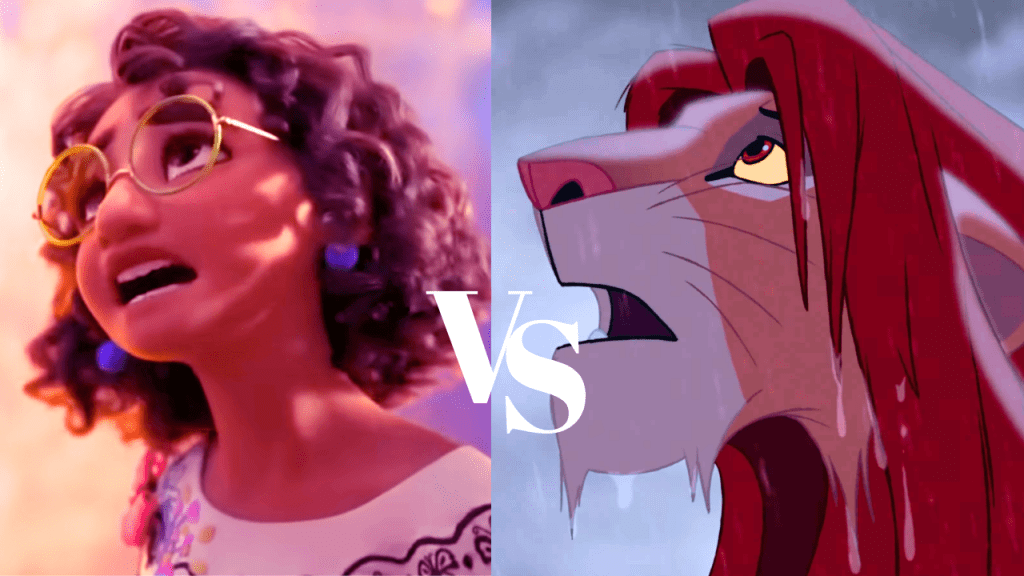
In many ways, Encanto and The Lion King are remarkably similar movies. They are both stories about family. Both explore themes of coming of age and learning to find your place in the world. They both involve the death of a selfless patriarch. Hell, both films even feature a weird, estranged uncle.
And this is to say nothing of the more mundane similarities of them both being animated Disney movies created for similar age demographics, and both making good use of the magic Disney formula: some catchy tunes, a heaping scoop of comedy, a generous sprinkling of genuinely emotional moments, and finally a moral for the audience to take with them after the experience.
And while we’re on the subject of the Disney formula, it’s worth pointing out that, for whatever missteps the company has made lately, there is simply no denying the imagistic power that Disney has held over the hearts and minds of people the world over. In fact, when Osama Bin Laden, the man behind the 9/11 attacks, was killed and his compound raided, it was found that he had in his possession, not one, not two, not three, but four different Disney movies: Cars, Home on the Range, Chicken Little, and the 1993 version of The Three Musketeers. The CIA speculated that these movies were kept around for the kids in the compound, but even so, if that doesn’t speak to the power of the brand, I don’t know what does. For better or worse, Disney has shaped the hearts and minds of generations. In fact, I would go so far as to say that Disney has played a core role in forming the moral imaginations of hundreds of millions, maybe even billions of people across the world.
And it’s with that fact in mind that I say for all of the similarities between Encanto and the Lion King, there are some very important differences. For one, they are separated by almost three decades. The original Lion King was released in 1994, whereas Encanto hit screens in 2021. This might not seem terribly interesting until you look under the hood and realize that despite being made by the same studio for the same demographic, using the same movie magic formula, and even containing many of the same themes, the ways in which these two movies develop those themes and the final messages they communicate about those themes are so radically different, so diametrically opposed to one another, that it is only fair to describe them as being antithetical films.
This will be a deep dive into the themes and underlying philosophies of a couple of cartoons, so if that does not appeal to you, then this is your exit ramp. But if you want to stick around, I’m going to show you why Encanto deserves the title the Anti-Lion King.
The Power of Stories
Now, before we jump into the nitty gritty, I can imagine one very basic objection that probably ought to be addressed: who cares? How does the subtext of a couple of kids’ movies matter at all? Why would this ever be worth anyone’s time?
And the answer is that it matters because human beings don’t really think logically. I mean, we do sometimes, like when we’re solving a math problem or trying to fix our electronics, but more often than not our reasoning is more emotional than rational. And this is because we understand the world through narratives, through stories.
Anton Checkov explored this idea in the short story “Home,” in which a father is looking for a way to get his very young son to stop smoking cigarettes. He realizes that he cannot use logical argument because the boy’s mind won’t respond to that approach. And if he simply uses force, then the boy will grow resentful and eventually reject his teaching. So instead, he uses the power of narrative, telling his son a story about a king whose son dies young because of smoking too much. After the son’s death, the king, who is getting old, has no one to defend him, and his enemies come and kill him. By appealing to the son’s natural love for his father, the story is more powerful than any command or argument, and the son tells his father that he will not smoke anymore.
Parents have long been aware of this power and have often cited the strong moral content of Disney movies as one the best qualities about them. But it’s not just parents that say so. A recent study published in the Child and Adolescent Social Work Journal examines the ways in which Disney movies specifically can play a role in the cognitive and social development of children. It even comes with a handy table with a breakdown of each film’s moral theme and recommended ages for viewing.
Oh and here’s a Google Scholar search result with 160,000 academic articles on the subject. So let no one say that there aren’t people who care about this stuff when there are academics literally building their careers off it. And they’re all doing the same thing I’m doing, the only difference between them and me is that I can do a muscle-up. So, with that out of the way, let’s get down to the nitty-gritty.
A Vision of Goodness
The Lion King tells the story of Simba, a young lion born into royalty and bound for power. The film begins with one of the most iconic scenes of all time, in which all of the inhabitants of the African Savannah gather round to celebrate the birth of their future king. All of these creatures are united in this thick web of meaning and order represented by their loyalty to this monarchical lion.
There’s not much point in laboring this metaphor with undue examination. Who cares about what kind of policies Mufasa enforces or whether the creatures on which the lions feed are a form of taxation without representation? These questions are irrelevant. The point is simply to understand this place as a kingdom and to see that the health of the kingdom is directly relational to the quality of its leadership. Mufasa is a good king and the green plains, blue skies, and multitudes of different wildlife testify to this fact.
This is the world into which Simba is born, and we see that his father is diligent in preparing him to take his place in this ordered vision. In just the few minutes in which we get to see Simba and Mufasa with each other, we are able to glean both that Mufasa has a deep love for his son, but also that he has high standards and expectations. Simba struggles to meet these expectations, as is shown in the scene in which he steps into his father’s footprint and glimpses the vast chasm which he will have to traverse in order to become what his father is. And while he is discouraged and intimidated by these demands placed on him, Mufasa’s confidence in his son reassures Simba that, in time, he will be ready to take on the mantle of king.
Encanto
The opening to Encanto is not so different. Maribel Madrigal is a member of the Madrigal family who are the de facto leaders of the pueblo in which the story takes place, and we begin with her grandmother, Abuela, explaining the story of the candle and the miracle to a very young Maribel. When Abuela was a young mother, she and her husband as well as many others were forced to flee their homes. But their pursuers caught up to them.
They killed Abuela’s husband and were about to kill the rest of them when a miracle took place. The candle which they had used to travel by was transformed into a magical flame and the area was converted into a magical valley complete with a magical house which has sheltered the family ever since. In addition to saving their lives and shielding them from dangers, the miracle provides each member of the family with a blessing, which each receives on their ??? birthday.
Each of these gifts comes with responsibilities, and this is most clearly seen through the character Luisa, Maribel’s older sister. Luisa’s blessing was superhuman strength, and as such, she’s got a lot of work to do. This gives her a very defined role in the community: what she does, other people can’t. Other gifts are less obviously useful, but the theme is consistent: the gifts that people receive are meant to be put to use in benefiting the community and their role in the community is determined by their gifts. At various times in the song, reference is made to the fact that all of these gifts come from “the miracle” and they must pass on that miracle from generation to generation, with each subsequent generation being responsible for carrying it forward.
The house, the valley, and the miracle are all representative of a particular, religiously coded, social order, and as in The Lion King, the goodness of that order is readily apparent in the beauty and affluence of the social body. The town is vibrant and beautiful, the people are happy, everyone is thriving.
The superpowers that each member of the family possesses are a metaphorical extension of the normal gifts that people are born with or develop throughout the course of their lives and which they are able to turn to the use of those around them. Those with physical strength are good at manual labor; artists beautify the lives of those around them; and so on and so forth.
Maribel is the sole exception to this rule. For whatever reason, when it was time for her to receive her gift, it was denied. Without over straining the metaphor, it is safe to say that she represents someone who doesn’t have any special skill and therefore, no special role in the community.
At the movie’s start, Maribel’s younger cousin is supposed to receive his own gift, and there is a concern that it will not happen, just as it didn’t happen for Maribel. But it does: the child is blessed with an ability to speak with animals, and while everyone else is celebrating, Maribel has another musical number in which she expresses her longing for a miracle of her own.
Now because the music is good, and the visuals are intoxicating, and every part of this scene is crafted to make us sympathetic to what Maribel is saying, it’s easy to miss that the root of her complaint is vanity. The song literally begins with her stoically saying that she will stay on the sidelines while the rest of her family shines, and then ends with her taking it back and saying that she is unable to do this. This cultural arrangement, despite its obvious goodness, has one flaw: it has marginalized Maribel. It is unacceptable to her that she should not be in the spotlight, and her song is an expression of the intensity of her desires to be honored and revered as the rest of her family is.
And, importantly, it is at the end of her song, after she has expressed this dissatisfaction with the miracle, that the cracks begin to appear in the house and the candle that fuels the magic begins to go out. Symbolically, the moral order begins to crumble when those within it become dissatisfied by it, when they stop believing in it. But Maribel looks away and when she looks back the house has returned to normal.
She is on the verge of dismissing what she saw as a hallucination when she hears her grandmother confessing a secret fear that the magic of the miracle is fading. When Maribel overhears her grandmother’s fears about the future of the miracle, she sees her opportunity to demonstrate her worth by rescuing the miracle and saving the family. And the first step towards this goal is to discover why the magic is fading in the first place.
Now, it may seem like this is just a movie about a quirky Hispanic family, but what is actually about is REGIME CHANGE. The Madrigal family aren’t just one family among a bunch of others; they are clearly something like a ruling aristocracy in this village. But even if we ignore that and focus strictly on the internals of the Madrigal family, it’s clear that ultimately this is about upending one value system represented by Abuela and everything that she does, and replacing it with another, represented by Maribel.
When you strip away all the filler, Maribel’s investigation consists of a series of interviews with three of her siblings: Luisa, Bruno, and Isabella. The first of these is Luisa, the hulk-like older sister who does the heavy lifting for the village and who Maribel catches up to outside the village where the two can have a bit of privacy and speak freely. Up to this point, Luisa has come across as totally stoic. But this scene shows that her stoicism is actually just a facade. Not only does the song begin with this some bizarre gloating from Luisa–
“I’m as tough as the crust of the earth is”
“And I blow cause I know what my worth is”
–she then goes into the song in which all the visuals become symbolic: Luisa is standing on a tightrope; Luisa is fighting Cerberus; Luisa is carrying the entire Earth. All of this is meant to show us the immense strain that Luisa’s responsibilities are putting on her. Coupled with this first complaint is a second about identity and self-worth— “I’m pretty sure I’m worthless if I can’t be of service;” “Who am I if I can’t run with the ball.”—and her desire to “break the crushing weight of expectation.” In other words, she dislikes that her sense of self-worth is tied to her ability to be of service to her community.
The problem is that Luisa’s complaint just looks like mental illness. Like, dude…ok, you have chores. Sure, they’re a bit more dramatic than usual, but they are essentially just chores. Yeah, the girl is busy, but she’s not actually being asked to fight monsters or carry the world on her shoulders. In fact, she’s being asked to do pretty reasonable stuff for someone with super strength. She complains that her sense of self-worth is tied up into the fulfillment of these duties to the people around her, but like what more do you want? Your a highly-valued member of the society and you’re complaining that it requires you to do stuff? This is just so…vapid and histrionic. It’s such bizarre, vapid whining complaint, that it begins to make sense that after this song, Luisa is going to become a bawling wreck for basically the remainder of the movie.
Luisa’s problem is that she cannot handle the responsibilities put on her by her gifts, and this is the overarching theme of the movie: the previous moral order, represented by Abuela, is flawed for two reasons. First of all, it requires too much of people. And secondly, it marginalizes some people in the same way that Maribel has been marginalized by her lack of a gift. And the movie’s central irony is that while Maribel is ostensibly trying to save the social order of the village (represented by the magic and the miracle) every step she takes along her journey ends up subverting what she is supposed to be saving: Abuela’s moral vision of how things should be.
But since this whole movie is about undermining the values of Abuela because of the pressure they put on her grandaughters, let’s take a look at the pressure she had to endure as a young woman: raising three children on her own in a new and unfamiliar place after witnessing the love of her life get murdered. And out of that tragedy, she has built a thriving community, and your complaint is that you have to do work in order to maintain it? Can you imagine Luisa singing about “pressure” to Abuela? Can you imagine Abuela responding? There’s one line from Luisa’s song that I do really like. It’s towards the end when she says “give it to your sister and never wonder if the same pressure would have pulled you under.” But however true this line is between Luisa and Maribel, it becomes absolutely laughable when Abuela is taken into consideration. The differences in what each of these woman has had to hold up under are not even comparable. It is a joke. But rather than acknowledge that Luisa is, for all of her physical power, totally lacking in grit, the movie does everything in its power to make it seem legitimate.
The trend is continued with Maribel’s second sister, Isabella, whose entire scene is about how she’s tired of being “perfect” and she just wants to be. [long sigh] But for as obnoxious as Isabella’s vibe is, this scene is one of the more interesting moments in the film because it actually does happen to touch (almost by accident) on something real. Beyond her shallow egotistical complaints, Isabella’s more significant complaint is that she feels limited by the expectations that have been placed on her. And she is in fact correct in this assessment. As the song continues, we see her power grow, doing things that had not previously seemed possible; and the result is impressive. And because it is so impressive, it’s tempting to believe that she’s right, that these restrictions, which were really just the expectations of those around her, should never have been placed on her to begin with. Tempting, but still wrong.
The problem is that Isabella didn’t give herself these powers. They were a gift, and a gift given with certain expectations, namely that she would use them to beautify the village. This is the typical arrangement between people and their folk artists. If Isabella was throwing off the weight of these expectations and these restrictions because she felt that it was stopping her from showing the people around her something even more beautiful, well it still wouldn’t be perfect, but it would be much better than this.
But that isn’t what we get, what we get is Isabella deciding that her priority as a creator and as an artist is going to be her own satisfaction, not any pleasure that she could offer to those around her. This is appropriate since the typical way that artists may go wrong is to forget their social commitments and fall into pit of perverse solipsistic self-obsession which causes their output to become increasingly self-referential and well…let’s just be honest, fucking dumb. This is how you wind up with art installations consisting of the jars full of the artists toe-nail clippings or the hair the collected from the comb. It’s how you wind up with Foutain or 60% of the collections inside the MOMA in NYC, and it’s what Tolstoy absolutely eviscerated in his scathing rebuke of decadent art. This book is an absolute banger. Everyone ought to read it.
I need to get back to the point. What both Luisa and Isabella have in common is that they both want to be released from their obligations and the expectations of other people, particularly Abuela.
In a blink-and-you’ll-miss-it moment during the Isabella’s song, Maribel notices that the cracks in the house are disappearing as Isabella sings. This is to indicate that the house, which once again, represents the social fabric of the village, is being restored by the Madrigal sister’s renouncing their obligations.
Following Isabella’s big orgiastic horticultural blowout, grandmother Abuela shows up and accuses Maribel of basically wreaking havoc on the family. But Maribel turns the tables and says, “no, you’re the one killing the family and destroying the magic.” As she’s saying this, the cracks in the house are expanding and the intent from the writers is clearly for us to see that Maribel is in the right, but at the same time, it is completely apparent that she is the one causing this to happen. This contradiction is caused by the fact that the plot and the themes have different needs at this moment. The plot has been building up the idea that Maribel is restoring the house not destroying it, but thematically and symbolically this makes sense because Maribel is at this moment challenging the authority that all of this, the house, the miracle, the blessings, rest on: Abuela. And this really is what it was always about.
Maribel says that the magic is dying because none of Abuela’s grandchildren will ever be strong enough or perfect enough for her. The problem is that…this is ridiculous? Abuela is not some slavedriver or abuser. In fact, she’s done literally nothing wrong except to have expectations of her family, and five minutes after this scene, Maribel is going to be crediting her with the fact that there is any family at all, which is absolutely true. But regardless, Maribel blames everything on her grandmother, and as she does, the house begins to fall apart until it has collapsed entirely and both the candle and Abuela’s dream have been extinguished.
Passing the Torch or Torching the Past
Since forever, society and civilization itself has depended on the moral underpinnings of two dual obligations which were laid on every successive generation: honor to the past and duty to the future. The past was to be honored for having produced the social goods that you enjoy, goods which it was now your duty to preserve, cultivate, and improve on for the coming generation. Responsibility to the future was the necessary acknowledgement that the world would not end with the current generation, that you were part of something greater that would extend beyond your own life, and therefore you had to leave things better than you found them. The notion of progress and the preservation of society depended on honoring these duties.
Both LK and EN deal with this idea, but differ in their attitudes towards it. Both begin by showing us a social order. In both cases, the goodness of that order is plainly visible, and in both cases, there is emphasis placed on the fact that the continuation of this moral order depends on each generation taking up their responsibilities and duties and carrying them forward.
For Simba, this comes in the form of his royal birthright. He will one day become king, the heaviest responsibility that his society can offer. But before that happens, in the meantime, he must make himself worthy. This seen after the young Simba has disobeyed his father’s commands and requires Mufasa to rescue him. As the group of them are returning home, Mufasa breaks off from the group and then sternly calls Simba over. And as Simba makes his way to his father, he takes a step that is too deep, and looking down, he sees that he has stepped into his father’s footprint. The size and depth of Mufasa’s print, the strength and weight of his body are all representations of the responsibility he bears, and in the comparison between Simba’s print and his father’s, we see the distance that Simba must travel to be worthy of what his father will leave to him; we see how much is demanded of him.
The same concept is briefly outlined in Encanto. We see it in the opening song in which Abuela sings a line about how each successive generation must do their part to carry on the miracle, but aside from that, there is little mention of this idea. This is because the entirety of the movie is a concealed complaint against this arrangement, and ultimately, a story about a generation abandoning those responsibilities by placing themselves at the end of history.
After the destruction of the house and the loss of the miracle, Maribel runs away and sits down at a river until Abuela comes to see her, and then she sings a song. The song is titled “Dos Oruguitas” and was originally sung in Spanish without subtitles in English. It is an explicit glorification of the future over the past. Oruguita means caterpillar and the theme of the song is how you must embrace change, how there’s no sense holding onto the past or being afraid of change in a world that is always changing. This is simply an expression of Futurism, which is, ironically, not a very new idea, though it was once a much more radical one.
Futurism was an artistic and ideological movement that appeared in Italy at the start of the 20th century. It was founded by the Italian poet Filippo Tommaso Marinetti, who published the Manifesto of Futurism in 1909, and held as its highest good an abstracted idea of progress and change. Marinetti and his compatriots valued speed, strength, and dynamism, and they praised revolutionary, even violent, change.
In the end, the revolutionary change that the Futurists got was fascism, so…good job, idiots.
But “Dos Oruguitas” shares with Futurists that same indiscriminate glorification of change. However, anyone who is not entirely historically illiterate should be well familiar with the numerous times in history in which change has proven to be negative, even disastrous. Even if you were so ignorant as to not understand this, the changes which forced Abuela and her husband to have to flee their homes in the first place ought to be sufficient example that some changes should be avoided.
Since it is clear from history that change is not always good, there must be some way of distinguishing good change from bad change. And you can’t very well tell which change should be accepted and which should be rejected unless you have some guiding light. A light, much like the candle that is extinguished when the house falls in Encanto.
But the candle qua candle can’t fulfill this role; it’s only a symbol for the thing which can: a telos. The concept of telos comes from Aristotle and it broadly refers to a thing’s purpose. The telos of a cup is to hold liquid, the telos of a chair is to provide a place to sit, ect. And there are entire hierarchies of telos where one contributes to the next. The telos of a gun is to kill from range, a purpose which is put to use by the soldier whose telos is to defend the state, which has the telos of defending its people and ensuring that they thrive. And all of these subordinate teloses are oriented and structured by the highest telos, whatever that may be.
After Abeula’s song, she tells Maribel that she had forgotten who the miracle was for and as she says this, we see a young Maribel onscreen, the obvious implication being that the miracle was for Maribel and her sisters.
That’s a problem.
Rather than the standard historical understanding of society and the responsibilities that each generation has to successive generations, Encanto makes the case that there is no need for tradition or the preservation of culture because Maribel and the rest of the current generation are the culmination of the entire historical process. It was all for them! And now that they’re here, how dare anyone try to place these burdens on them!
One can hardly avoid mentioning is why there is no positive mention of having children, and only one of the women in the film even gets into a relationship. In a movie about people rejecting the duties that have been placed on them, marriage and parenthood–two of the most profound duties that a person can possibly have put on them–are going to be a tough sell.
In the place of these historical obligations to past and future, Encanto enshrines something else.
When Abuela and Maribel return to the village, the family is faced with the task of rebuilding their home without the use of their gifts. But with the help of the village, they succeed in reconstructing the house, and at the end of the process, Maribel is given a doorknob…yeah, ok, it’s silly, but it’s not as silly as it sounds. And as she approaches the newly completed house, all of her family are gathered around singing her praises, telling her that they “see” her.
“We see how bright you burn.
We see how brave you’ve been.
Now see yourself in turn.
You’re the real gift, kid, now let us in.”
Maribel has gone from being a marginal figure in the family to being its center. A new foundation has been laid for the family, and Maribel is the bedrock of that foundation. She puts the doorknob into place and the magic is restored to the house. Everybody gets their powers back and the celebratory wind down begins. This is the movie’s way of saying that everything is going to be just as good as it was before, actually, even better. But has anyone asked where this magic is coming from? The candle was basically a case of divine intervention, and it’s gone. All the Madrigals have done is build a house, which is definitely cool, but it’s pretty far from miraculous. Is it coming from Maribel? Is it from the family itself? The question is never answered; it is never even asked.
Instead the first thing that we’re shown is how our two auxiliary female leads have changed. Luisa is strong again and back to doing her strong-girl thing, but she picks up one vase and is then basically thrown into a hammock and provided with a cocktail. This is the primary selling point of the new social order that Maribel has founded: you will have less work and more leisure; you will have fewer restrictions and more freedom; you will have less duty and more ability to focus on yourself. In all respects, there is a release from obligations and restraints based on meeting the needs of other people. And anyone with a keen eye has probably already guessed where this is going. The message here is basically indistinguishable from “hakuna matata.” It’s the language of the Oasis, just with an artistic gloss that makes it harder to see: no rules, no responsibilities, no worries.
At this point someone might object to my analysis on the grounds that there are still responsibilities, they’re just more reasonable. The reason why this objection is wrong is because the expectations were always reasonable. The only possible exception is Isabella’s being pressured into an arranged marriage, and even this is a marginal case. In every other case, the expectations are so moderate that the reactions that the sisters have to them look unhinged. Luisa isn’t actually being asked to fight monsters, Isabella isn’t actually being asked to be “perfect.” But both represent themselves as if they are being oppressed by their grandmother because she wants them to be grown-ups. The greatest irony is that this story about a magical third-world family is absolutely stuffed with First World fragility.
Leaving the Oasis
On the other hand, Simba is eventually called out of the oasis and compelled to return home to take up his burdens. In part he’s driven by his romance with Nala, who pressures him to return. But this alone could never be enough. He’s also driven by a deep, complex longing within himself.
In one of the oasis scenes, the trio of friends are lying on their backs admiring the stars and they begin discussing their different theories of what they stars actually are. Eventually they ask Simba for his guess, and he says that someone once told him that they were the great kings from the past, looking down on them, and in this moment, the question of stars fades from view, and instead we see the thing they represent, the immense weight of the past and the dreams of those who lived there.
The moment is broken with the bathetic intrusion of Timon who pours cold water onto the idea, turning it into a joke, much like any given Marvel movie. And Simba laughs too, but only for a moment. He becomes distraught and leaves the group, ashamed at himself for having laughed at what he knows is sacred: the memory of his father.
Later, after his argument with Nala, Simba wanders out into a grassland where he wrestles with his own ambivalence regarding the way his life was worked out. This quickly leads him to thoughts of his Mufasa, who was supposed to guide him to become the person he was meant to be.
In Simba’s mind, he is the author of his own downfall, but even if he’d grown up under his father’s guidance, things might still have gone wrong. It might have seemed too natural to him to take the throne; he might even take it for granted and become tainted with privilege and entitlement and vanity; he might have become a bad king. This possibility is made all the more believable by the extremely catchy musical number “Just Can’t Wait to be King” sung by the young Simba.
Perceptive viewers will note the similarities between this song and Scar’s big number, “Be Prepared.” Both are about the longing to wield power and be recognized, but while Simba’s is cute, Scar’s is threatening. The attitudes of children become dangerous when they inhabit the bodies of adults. Maturity was supposed to drive out this egotism and vanity from Scar, but it has failed to do so, and as a result, when Scar takes power, things go to shit pretty quickly. By the time Simba is an adult, even the hyenas who are basically Scars base are dissatisfied with Scar’s rule, and unfavorably compare him to Mufasa. In this way, Scar is a reflection of the kind of king that Simba might become if unable to humble himself.
Simba’s journey to the oasis, his remorse over his father’s death, and his shame in front of Nala’s expectations are all waystations on his path to this humility, and at the end of this path, he sees an apparition of his father. And this Mufasa doesn’t validate his ego; he doesn’t say, “You’re doing just fine kid. I’m proud of you for eating bugs while your people starve, after all, you’ve had a rough time. Do you need a hug, buddy? Need a good cry?” If anybody could be forgiven for asking to be left to his own devices, Simba has a pretty good claim to it. But instead, Mufasa voices his disappointment and he challenges Simba to be more. And Simba finds within himself the courage to rise up to this challenge.
He returns to do battle with Scar and succeeds in removing him from the throne, but there’s one last task to complete: Simba must take his place. The emotional weight of this moment as Simba, battered and exhausted, drags himself to the pedestal of the mountain and sees the clouds part and the stars, the embodiment of all the greatness of the past, gaze down on him is so far beyond the trite celebratory ending of Encanto, that it takes a half-hour-long video essay just to attempt to explain it.
The Heroic vs. the Therapeutic
If Encanto is supposed to be some reflection of the hero’s journey, it’s a bizarre one. Where Simba has Scar and hyenas, there is no obvious antagonist that Maribel has to overcome. In fact, Encanto is part of a growing trend in Disney movies where there is no real antagonist at all, a trend which Disney’s centennial celebration film, Wish, tried and failed to rectify.
Rather than confronting villains, these recent films focus primarily on internal critiques, attacking the social or moral order that they are ostensibly a part of. The only character in Encanto that even comes close to fulfilling the role of classical antagonist is Abuela, and that’s only because of her proximity to the film’s true enemy: the past and the obligations that it places on those in the present. And whereas the final spoken word in Lion King is Mufasa’s injunction to Simba to remember, Encanto is all about forgetting, about letting go of the past, and then assuring the audience that nothing bad will come of it. And whereas Simba has to grow in order to reach the end of his journey, Maribel doesn’t change at all. For the entirety of the film, her character is basically static, presumably already perfect from the first frame.
Her journey isn’t heroic; it’s therapeutic. Though ostensibly her goal is to save the miracle and the family, her real goal is related to her wounded ego and her feeling that she is not properly valued. The expression of this desire is the entire point of the song, “Waiting on a Miracle,” which she sings right before the film’s inciting incident and before taking on the task of saving the miracle. And the fulfillment of this wish is the movie’s culminating moment. Yes, she does also succeed in rescuing the magic, but this is only accomplished by a hasty deus ex machina, a bit of sleight of hand from the writers. From the point of view of the plot, there is no reason for it to happen. If the movie had ended with the Madrigals losing their gifts and finding a way to live and thrive without them, that would have been far more honest, and more poignant as well. And maybe it would have succeeded in being a more meaningful flick, but that couldn’t happen because it would imply that such forgetting comes at a cost.
But the more important reason that Encanto’s ending is not heroic is that it simply can’t be, by definition.
Heroism
In both films, there is a pivotal moment towards the end in which each of protagonist beholds something that is, for lack of a better word, sacred, holy. For Simba, the moment comes when he ascends the crest of Pride Rock and the clouds part and he sees the stars and all that they represent. This is what he was willing to leave the oasis for, what he was willing to face social ostracism and guilt for, and even risk his life for: the dream of his father and the train of history that he represented. The stars are Simba’s candle, and the stars never go out. But what is the corresponding moment for Maribel?
It comes at the moment when Maribel sees her own reflection in the door knob. For Encanto, the most important thing up for consideration is the self. And if we look back through the movie, this is the thread that unites all of the sisters who form the foundation of the narrative.
Each of them is dissatisfied with the arrangement because it demands something of them, or conflicts with their own narrow desires. Maribel resents that she doesn’t have the same status as the rest of her family because she lacks a gift. Luisa resents that her worth is determined by her ability to be useful because this means that if she were to stop doing useful things, she wouldn’t have the same level of status that she currently enjoys. And Isabella…well, Isabella just doesn’t want anything standing between her and the love affair that she wants to have with herself.
And the film’s ultimate solution is simply to remove the constraints and impositions made by other people on the heroines, setting them free to indulge their own self-absorbed desires.
This is the exact opposite of heroism. Heroism by definition requires that a person sacrifice themselves to a good that they place over and above their own preservation. There is nothing transcendent to be found here, nothing to look up to, nothing to sacrifice for, no stars to be seen. All one can do is focus downward and inward, fixating more and more intensely on one’s own satisfaction. And Encanto treats this as if it were a new foundation for a new social order, but in reality all that is happening is that the social fabric that it all rests on is being degraded, and the people of this social network are becoming more atomized.
This is the fundamental difference between the two films and the reason that each feels so different in its ending. Encanto’s ending feels celebratory, but not triumphant. After all, what has really been accomplished? Nothing has been overcome; all that has occurred is that the Madrigal sisters have become a little more self-involved and Maribel has become a star for convincing them that that’s fine. It feels cheap because it is.
This isn’t to say that people can’t or shouldn’t relate to the feelings of being overworked, or left on the sidelines, or unfairly maligned. But on the hierarchy of emotions that can be drawn on for a work of art, they are fairly…trivial. They represent our weakness, our moments of stumbling and selfishness, and while it may feel good now and then to give in to a little self-indulgence, it is unlikely to get you anywhere that you want to be.
Similarly, those who place the self as their highest icon and pursue its satisfaction at the expense of everything else may find that they are left feeling hollow and unsatisfied. In contrast, the feelings evoked by Simba’s journey are deeper and more substantial, more costly and ultimately more beautiful. Rather than being focused inward, they are focused towards the horizon, towards something that can only be described as hope–the idea that our deepest longings and our highest loves will be preserved in a future that we may never see.
Because those who abandon the past, have a funny habit of abandoning the future with it.
In the final seconds of The Lion King, we see its beginning echoed. The animals are once again gathered at Pride Rock, and Simba and Nala give their own child over to Rafiki to perform again his coronation—an indication that this world, this way of life, this goodness will continue on. Though Scar’s rule represented a break in its continuity, the proper order has been restored, and we can trust that it will be preserved into the future.
In contrast, the final frames of Encanto show the Madrigals gathered together for a photograph, which then lingers for a moment in front of the viewer before the credits begin to roll. Rather than embracing the future, the film attempts to escape it with a fixed moment, held outside of the flow of time, leaving not a legacy but only an artifact, as if the writers on some level knew that this was the consequence of their futurism, that we cannot have any hopes for the future. To have those hopes, those dreams, would require putting expectations and obligations and restrictions on the people of the future, and as our protagonist has spent the last hour trying to convince us, that just wouldn’t be right. In fact, it would be the height of hypocrisy to expect some sense of obligation from future generations after having abandoned one’s own duty to the past. And so, with no hopes for the future one must resign oneself to either disappointment or blind acceptance, saying that whatever the future holds is what it should hold.
And this means that in the last analysis, a blind commitment to the future, to change itself, finally reveals itself to be a commitment to nothing at all. No one knows what the future holds, no one can guess its shape or its character, and so to love it is to love a cipher, a zero. And those who commit themselves to this cipher are likely to find that in the end, the world that greets them from the future may have very little worth appreciating in it, and that the best of their lives is now found only in memories.
 The Barking Years
Leave a comment