
So much of our personalities are the accretions of the lessons (good or bad) that we took from our childhoods. In my case, having grown up in a deeply dysfunctional household where one was always walking on eggshells, I developed a belief that things matter, even (and possibly especially) small things. This belief doesn’t always serve me. I’ll admit that I am prone to reading into things to an unhealthy degree, and that it has been known to lead me to the occasional odd conclusion. However, I am always on the look-out for the situations in which this quirk of mine may be put to use. And I suppose that’s why, even though it’s been a few weeks now since the “Bear Question” went viral, I, inveterate over-thinker that I am, still want to know what it all means.
Some quick backstory for the random web-traveler who will somehow stumble across this post in a few years while trying to research something totally unrelated: if you want the actual rundown—here—but the short version is that a TikTok video went viral in which women were asked whether they would rather encounter a man or a bear in the woods and the large majority said “bear.” The original video has now been liked 2.2 million times. It has some 60k comments and about 150k shares across platforms. Innumerable accounts have made their own posts about it. I think that at this point, it has reached “What color is this dress?” levels of virality.
Now that USA Today has covered the same story saying that it has “sparked a conversation about women’s safety,” I feel like we should have reached the point where something can be said about all of this.
First of all, the thing that most needs to be said of it is of course that it is utterly idiotic and should not be taken seriously at all. I’ve been informed that most men suddenly “get it” if the question is reframed so that the woman in the hypothetical is their daughter, so allow me to report that even if this were the case, I still am vastly more comfortable about the prospect of my daughter encountering a man than a bear. I am able to say this because I am not suffering from any drug-or-social-media-induced brain damage, although I think that even the majority of people who are mentally handicapped would be able to pass this little test.
The second thing that ought to be said, related to the first, is that none of these people mean it. None of these women actually believe the things that are coming out of their mouths.
If it were true that women are so frightened of men that they did truly believe that an average man poses a greater threat to them than a bear, if this is meant to be the basis for a “conversation” about women’s safety, then I just don’t see how that conversation can be had. Conversations occur between parties who share a comparable capacity for reasoned discourse. And if it were true that women believed this, it would indicate a degree of bigotry so profound that the person possessing it should probably simply be left in the lightless pit of their own mind. It would also indicate that the mistreatment of men and the constant fear-mongering to women in the media have so successfully deformed the minds of women that one struggles to imagine any way back from it that does not involve “reeducation” even if that reeducation is simply in teaching data literacy to the numerous women who thought that citing statistics on the comparative rates of killing between bears and men proved something about the world rather than proving something about their ability to interpret statistics.
But like I said, it isn’t.
It is just a demand for pandering.
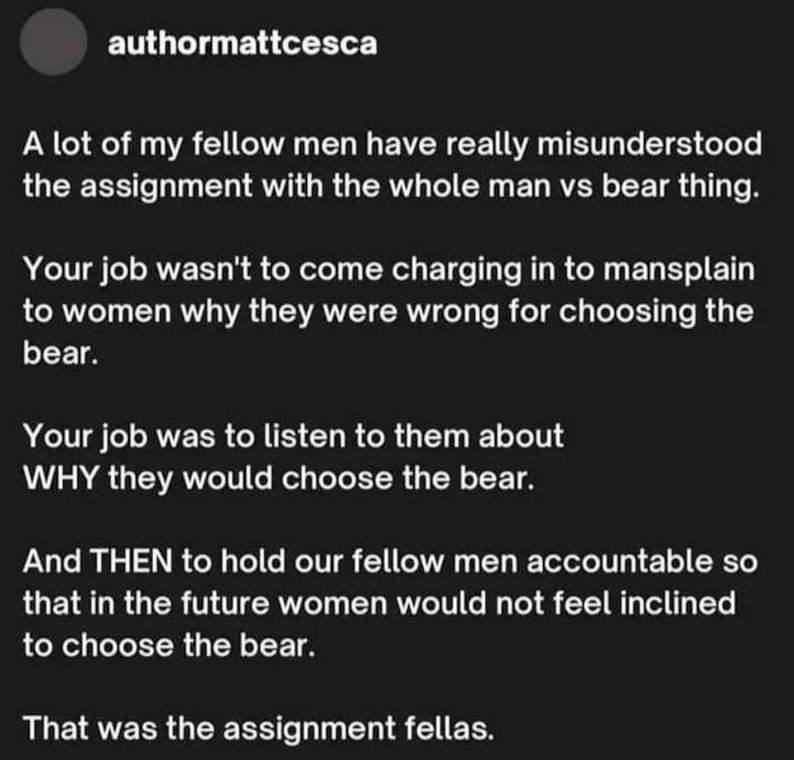
As if there is anything to be said on this topic that any adult man has not heard repeated ad nauseam for years. The assumption here is that no matter how ridiculous a woman’s claim might be, no matter how insulting, the proper response from men is to treat it with the utmost seriousness. But I’m afraid this type of performative self-victimization is rapidly losing its cache.
The whole thing reminds me of the kinds of taunts boys might once hear from girls on a schoolyard. It feels…like a shit test. It feels like the thing that you are supposed to do, the way to “win” the scenario, is essentially to treat it as something obviously absurd that should not only not reflect on women as a group, it should not even reflect on the particular women who are saying it.
On first blush, this might seem like the more attractive possibility, but it comes with problems of its own.
For one, it presents a problem for men in deciding how to respond to situations like this. Are they meant to take this seriously or not? If the answer is yes, then men are put into a bind because the claim is so obviously and insultingly absurd that it immediately discredits the person voicing it. And yet men are told to respect women, so what happens when women do something that can’t be respected? Even the actions of men who honestly and sincerely attempted to convince women that they are being silly, that a bear is obviously more dangerous, even this has been framed as being something like sexist bullies.
Sure, men might respond by saying “well, those women are just crazy,” but is this not itself taken as a sexist reaction with a long and storied history. Wasn’t this the core claim of The Madwoman in the Attic? Weren’t these the core sins of Freud and all the other early performers of psychotherapy who so regularly diagnosed women with “hysteria.” Clearly, this an unwinnable scenario and one that men, especially any man protective of his public image, will seek to avoid.
So let’s examine option B: this is not meant to be taken seriously. This presents its own problems. For one, in an ostensibly egalitarian society, the idea that the “passing grade” for a man in this situation comes from not taking the voiced opinions of women seriously smacks of old world chauvinism. Let’s ignore for a moment the insulting nature of the claim, the idea men (and especially “real men”) should simply smile at it all, chalk it up to that lovely imbecility of women which is part of what makes them such marvelous creatures, and not lose a moment’s composure over the whole thing. If one can work in a playful smack on the bum along with this confident dismissal, well that’s pretty keen too.
I’ve heard women saying something like this (I assume seriously) and I’m not entirely sure that they have thought this through. This kind of thing works when a relationship is good, when both parties feel comfortable and they trust the other. In that context, this little episode might be understood as some good-natured flirtation between the sexes.
“I chose the bear because I know what kind of animal you are,” said with a tilted eye-brow and the slightest hint of a smile.
Yeah, that’d be swell, but that’s not the scenario that we have. What we have is a situation in which many normal men are genuinely confused about what degree of respect women want them to have for the things that women say. And if the existence of this essay were not sufficient evidence in itself, I will go ahead and admit that I am one of them.
I’m also not sure how the question can be answered. What seems clear to me is that any successful arrangement between the sexes (meaning one in which regular men and women are able to form happy, lasting relationships) will require some recognized set of complementary duties that each sex owes to the other as well some kind of accepted mechanism for criticizing members of the opposite sex when they fail to uphold their end of the bargain. At this point, I think the direction of the discussion must diverge into a number of related paths that I can’t follow here, but these might be fruitful options for further examination.
- What might a successful dispensation between men and women look like in the post-industrial world?
- Given that all of our legal structures in the West are calibrated towards egalitarianism and against complementarity, how could interested parties begin to create complementary communities without having those communities undermined by lawsuits which would prevent them from being able to police themselves?
- What factors have contributed to the current toxicity of discourse between the sexes? How can these be guarded against?
And finally, I think the last is a more general kind of question.
- Is there anything that can be done to secure a realm for “serious” discourse?
Yes, I know that the internet is drenched in irony, that nothing said there should be taken seriously. And I have often noticed this point of view being used to brush aside various areas of the discourse as “unserious.” And I guess I have always had the same question: But where is the serious discourse? The serious conversation never seems to arrive. Or it does, only to be immediately ousted by the non-serious conversation.
The reason for my concern is that, no matter how clearly marked this “unserious” discourse is, if we do not have a place for the real thing, then I suspect that the content and texture of our real lives and relationships are going to be molded more and more by this “unserious” discourse.


 The Barking Years
Leave a comment