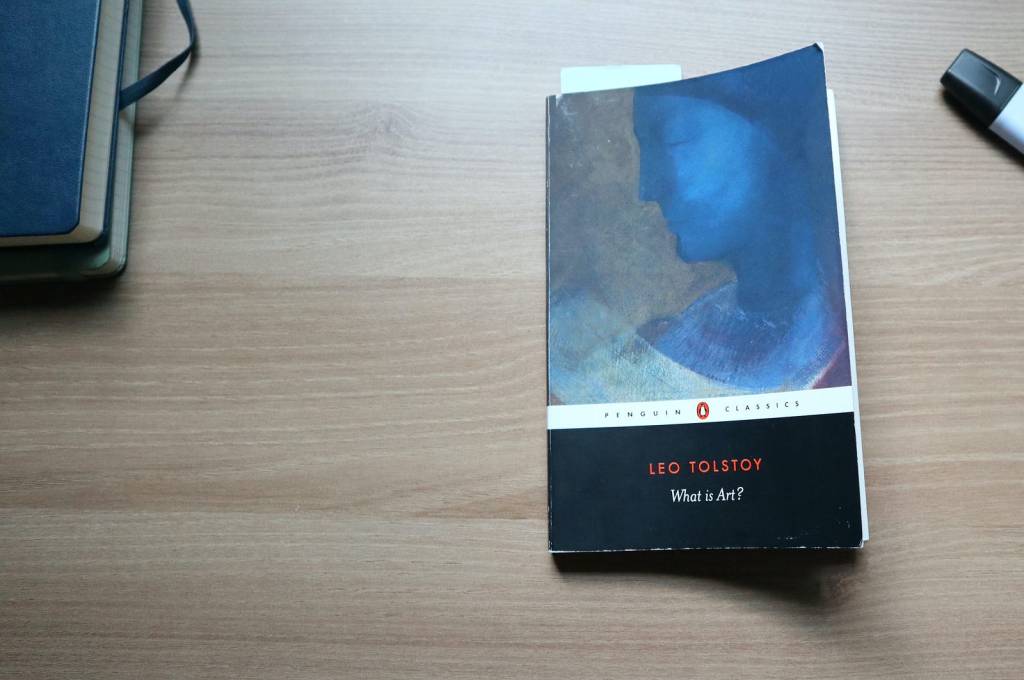
“I know that the majority of people who are not only regarded as intelligent but are indeed intelligent, capable of understanding the most difficult scientific, mathematical and philosophical reasonings, are very rarely capable of understanding a most simple and obvious truth, if it is such as requires that they admit that a judgement they have formed about something, sometimes with great effort, a judgement they are proud of, which they have taught to others, on the basis of which they have arranged their entire life — that this judgement may be wrong. And therefore I have little hope that the arguments I am presenting about the perversion of art and taste in our society will be, not accepted, but even seriously discussed, and yet I must speak out to the end what I have been ineluctably brought to by my study of the question of art. *This study has brought me to the conviction that almost everything regarded as art, and good art, and the whole of art in our society, is not only not true and good art, nor the whole of art, it is not even art at all, but only a counterfeit of it.*”
Tolstoy begins his inquiry with a scene of a rehearsal for an opera. He notes the sheer number of bodies involved in the production, mostly actors and actresses (whose costumes are as immodest as can be tolerated by the culture) and musicians, but also simple laborers necessary for more ho-hum work that goes into the productions. He makes special note of the conductor, who seems to make a show of being as cruel and arrogant as possible, hurling insults at the cast and musicians. After a particular scene is started and stopped more than a dozen times, the absurdity of the situation reaching its apogee, Tolstoy writes:
“Involuntarily, a question comes to mind: for whom is this being done? Who can like it? If there are occasional pretty tunes in the opera, which it would be pleasant to hear, they could be sung simply, without those stupid costumes, processions, recitatives and waving arms…And all this vile stupidity is produced not only with no kindly merriment, with no simplicity, but with spite and beastly cruelty.
It is said that this is done for the sake of art, and that art is a very important thing. But is it true that this is art, and that art is such an important thing that such sacrifices should be offered to it? This question is particularly important because art, for the sake of which the labour of millions of people, and the very lives of people, and above all, love among people, are offered in sacrifice, this very art is becoming something more and more vague and indefinite in people’s minds.”
The task for him then becomes clear: to answer the titular question and see if art can justify itself. What follows is a lengthy and very impressive tour of the field of aesthetics up to that point, at the end of which, he affirms a radical new thesis: the problem with defining art, with the theory of art in general, is a) that it has been mistakenly tied to the concept of beauty which is itself deeply unstable and contested and b) that previous theories of art have been based on merely trying to create a definition to contain a set of works that are seem to be bound by nothing other than the fact that a certain upper-stratum of people have enjoyed them.
In Tolstoy’s analysis (which I find extremely compelling) nearly all of what we know as “fine art” is actually counterfeit art. “True art” must fulfill two vital criteria: it must express a genuine emotional experience from the artist to his audience (Tolstoy uses the language of “infection” frequently. True art “infects” the viewer/listener/reader with the emotion of the artist. If it fails to do this, it fails as art.); and it must be guided by the religious consciousness of the age. To explain what Tolstoy means by the “religious consciousness” is a task in and of itself. Suffice it to say, Tolstoy’s relationship with Christianity was a strained one and his views were highly unorthodox. According to him, Christianity, the “true” teachings of Christ, have been polluted by the Church where it was amalgamated with paganism and idolatry, worship of a whole heavenly hierarchy of divinities that resemble the pagan pantheon.
To him, true Christianity was the Bible when denuded of all its supernatural elements because they were an intolerable irrationality in the eyes of Tolstoy. True Christianity resembles something like the basic substance of religious feeling described and documented by William James in Varieties of Religious Experience, and his view on spiritual progress seems to be something straight out of Hegel (though this is not made explicit and he at times seems antagonistic to Hegel, which is puzzling to me.) Tolstoy imagines basically two kinds of true art both of which serve their own purpose: pioneering art, and art which is essentially a kind of spiritual food to the people. One serves to advance society, the other serves to maintain it. But the way Tolstoy imagines pioneering art (this is not a term that he actually uses, I’m having to employ it as a practical measure) is very different than how many today might imagine it.
The history which Tolstoy tells is one in which art undergoes a significant perversion sometime during the course of the 17th(?) century or maybe the Renaissance. I don’t think it’s ever given a precise date and seems mostly to be a matter of the event itself: the upper classes, those possessing wealth and education, are no longer able to believe in the religious world view of the people. The teachings of the Church are no longer compelling to the upper classes, but they recognize the utility of religion both in how it sanctifies their own power (Hobbes is noteworthy here) and provides moral and social stability. But instead of pushing forward to Tolstoy’s “True Christianity,” the ruling classes have nothing to replace the faith that has been lost, but they are the ones most disposed (in terms of having the leisure and financial ability to provide for it) to the creation of art. It is at this point that Aesthetics at it is now known is born (though it has not yet been named and this will not occur until 1735 with Baumgarten’s Philosophical Meditations from Nowhere): the purpose of art becomes the celebration of beauty (but beauty as understood by the leisurely and upper classes) and enjoyment.
Art grows so narrow that it reflects almost exclusively the concerns of the upper classes and becomes preoccupied with the subjects of the tediousness and boredom of living and sexual licentiousness/depravity (the decadents such as Huysmans and de Sade being the prime examples). The content of art becomes, in this way, so limited that it is quickly exhausted and overcome with the feeling that there is nothing left to be said. At this point, the emphasis shifts to originality of form and technical virtuosity. Literary arts and poetry especially becomes indecipherable to the average person. The poetry of riddles and trickiness, of being willfully obscure comes into vogue because the substance has become stale and all that remains is to “game-ify” the form. Indecipherable gibberish becomes celebrated. Even the educated classes for whom the new art began can no longer keep up with the changes in form and art becomes increasingly exclusive.
This entire edifice of bad, spiritless art is held together by something like a Ponzi scheme sustained by professional artists, art critics, and art schools. Instead of this pioneering of new and “original” forms, Tolstoy states that the highest form of art is for the artist to stand at the furthest spiritual precipice of the age he lives in and try to extend the ground a little further towards “the Good.” In doing so, he gives rise to a new and original emotional experience, a new feeling, and allows others to share it with him. The other half art is dedicated to the benefit of all people and allowing them to strengthen the ties of communion which bind them by sharing in common feeling and common understandings of the good.
Overall, Tolstoy’s argument is, I think, a strong one, and there are towards the end some obvious echoes (well I guess not since he surely predates her) of the sentiments found in Simone Weil’s The Need for Roots. This is especially true in his conclusion in which he emphasizes the spiritual necessity of labor, which Weil even went so far to place at the center of spiritual development.
A marvelous book that more than earns a place on my top shelf beside Kierkegaard, Weil, Bataille, and Bloom.
Excerpt
Upon viewing a performance of Wagner’s Nibelungen.
“This is all so stupid, so farcical, that one wonders how people older than seven can seriously attend to it; yet thousands of quasi-educated people sit there, listening and watching attentively, admiring it…If there is anything resembling the beginnings of music, these beginnings are so brief, encumbered with complicated harmony, orchestration, effects of contrast, they are so obscure, so unfinished, and with all that the falsity of what takes place on stage is so repulsive, that they are hard to notice, to say nothing of being infected by them. And the main thing is that the author’s intentions are heard and seen from the very beginning to the end, and in ever note, so much so that one sees and hears not Siegfried or the birds, but only the limited, self-confident bad tone and bad taste of a German, whose ideas of poetry are absolutely false, and who wants, in the most crude and primitive fashion, to convey these false notions of poetry to me.
Everyone knows the feeling of distrust and resistance evoked by the obviousness of an author’s intentions. A narrator need only tell you beforehand to get ready to weep or laugh, and you are certain not to week or laugh; but when you see that the author not only prescribes that we be moved by something that not only is not moving but is ludicrous or repulsive, and when you see, furthermore, that the author is unquestionably certain that he has captivated you, the result is a heavy, tormenting feeling, similar to what anyone would experience if an ugly old woman, dressed up in a ballgown and smiling, twirled in front of you, certain of your sympathy. This impression was reinforced because I saw around me a crowd of three thousand people who not only listened obediently to this totally incoherent gibberish, but considered it their duty to admire it…
Listening to this opera, I could not help thinking of a respectable, intelligent, literate village labourer — one of those intelligent, truly religious men whom I know among the people, — and imagining the terrible perplexity of such a man if he were to be shown what I had seen that evening.
What would he think if he knew of all the effort expended on this performance, and saw that audience, the might of this world, whom he is accustomed to respect, these old, bald-headed, grey-bearded men, sitting for a good six hours in silence, attentively listening to and watching all this stupidity? But, to say nothing of an adult labourer, it is hard to imagine even a child of more than seven who could be amused by this stupid, incoherent tale.
And yet a huge audience, the flower of the educated upper class, sits through these six hours of mad performance and leaves imagining that, having given this stupidity its due, it has acquired a fresh right to regard itself as progressive and enlightened.”
 The Barking Years
Leave a comment