
I Sat Down with the International Smash Hit
Earlier this year, the English speaking world was treated with the sequel to Baek Sehee’s best-selling memoir/self-help book, I Want to Die but I Want to Eat Tteokbokki. The original, which was self-published in Korea in 2018 and received its translation and international release in 2022, became a runaway success, selling 400,000 copies in Korea and, as of 2024, a million copies worldwide. Those are strong numbers for any book, but for a nonfiction work on the subject of mental health and therapy, it is frankly astonishing. And a week or so ago, I finally decided to sit down with the best-selling sensation.
…It’s actually pretty bad.
The structure of the work gets established early on, and Baek (Baek is actually her surname; the order is reversed in Korean) sticks to it for about 80% of the book’s length. There will be a brief introduction to the mental health topic that Baek wants to explore, followed by an excerpted transcript from one of her therapy sessions, and the chapter will then end with some more generalized (and usually more positive) thoughts on the subject. There is nothing wrong with this structure. It’s totally solid. The issues are unrelated to the basic form of the work.
My issues with this book were entirely related to a) the quality of the writing and b) the quality of the ideas discussed.
Let’s take those in order.
The Writing
When it comes to translated works, there are certain kinds of badness that a reader needs to be able to get over. Sometimes certain expressions may simply be deeply dependent on the host language, requiring a skillful translator in order to convert the spirit of the sentiment while navigating various issues of usage and connotation that may obscure or distract from the author’s meaning. At least some of the issues with this book may be of that variety. When you run into passages like the following:
I want to shed all tedious emotions…I don’t want others’ emotions or behaviors dominating my mood, or negative thought processes imprisoning me in the land of extremes.
Or
To me, sadness is the path of least resistance, the most familiar and clost-at-hand emotion that I have. A habit that has encrusted itself onto my everyday.
Here’s a little piece of advice from someone who is not bilingual but nonetheless knows how to write a sentence that doesn’t suck: if ever you are writing or translating anything and you find yourself using the word “encrusted,” it’s time to ask some questions like “Is my heart still this?”
There’s the possibility that this stuff doesn’t sound this awful in the original Korean, but excerpts like the above are far from rare throughout the book and they constitute a consistent barrier to enjoyment. Somebody is to blame. Either Anton Hur (the book’s translator) is not good at his job, or Baek is simply not a good writer. However, Hur is a writer himself and was long-listed for the International Booker Prize in 2022, and Baek is apparently a formally trained creative writer who spent five years working in a publishing house, so at least in terms of the credentials, it’s not immediately clear who dropped the ball here. Regardless, this is not a pleasant book to read. There are no fine lines or memorable quotes and much of the writing is mired in tonally bizarre or awkward phrases. For any reasonably literate English speaker, the experience is subtly and consistently unpleasant, like trying to put on a damp sock.
But style is actually a secondary concern to a far more important issue: everything in this book is hopelessly insipid.
What’s the Deal with the Substance?
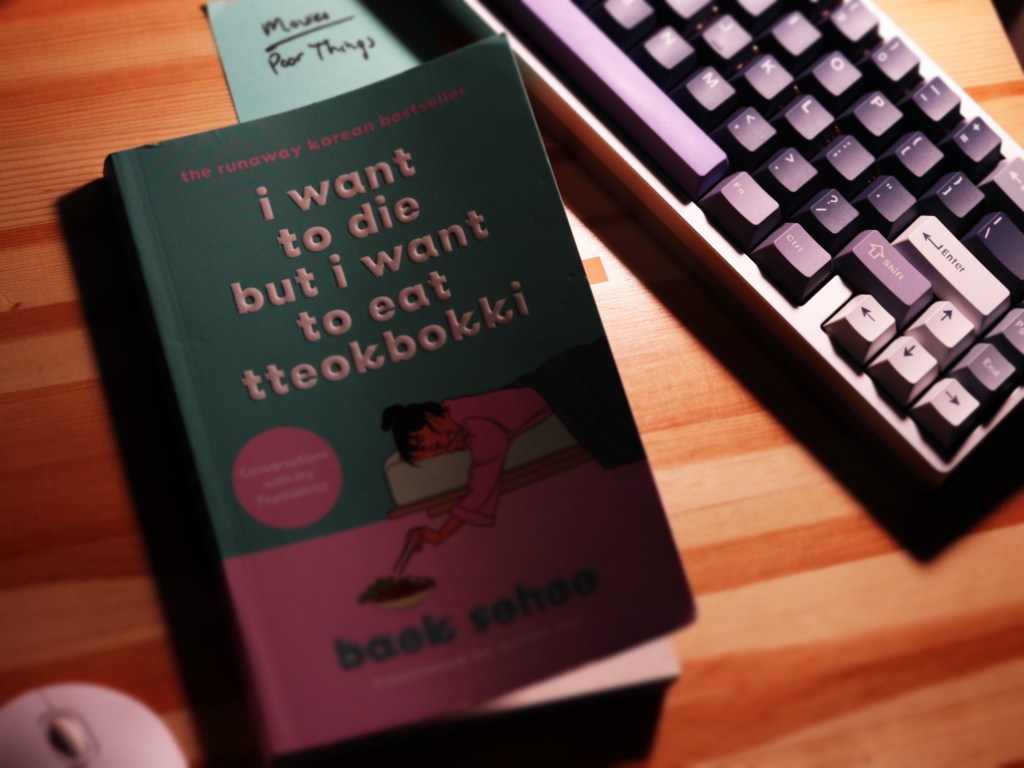
I’m happy to accept that I have read an unusual amount of material relating to psychology and philosophy and am therefore smarter and better looking than everyone else on this planet (i’m not even joking i really do believe this for real for real on god), but still, I can usually find things to appreciate even in unlikely places. But there was absolutely nothing in this book that even came within a broad shot of being profound or even interesting to me.
The therapist himself is an insufferable nitwit, and the advice he gives is no more substantial than you could expect from spending a few minutes on r/mentalhealth. It’s so bad that even he even have a note in the postscript in which he lament how poor the quality of treatment that he gave was, “I read the book only when it was published, and I was even more embarrassed than I had expected to be as I regretted some of my counseling choices and wished I could’ve been a bigger help to the author.”
I don’t want to be a dick here (well…I mean more of a dick than I’ve already committed myself to being), but the embarrassment is well-earned. I had originally borrowed this book from a friend and after reading the transcript of their first therapy session, I had to order my own copy because I knew that it would be unbearable to read the remainder without being able to scribble notes like “are you fucking high?” and “lol, wAaAaT??” in the margins whenever he gets going. Here’s a sample.
“Right now, your relationship is narrow, like a triangle, and pierces your heart, but at least a dodecahedron is closer to a circle than an octagon, right? The deeper and more varied relationships you have, the rounder your mind will be, and the less the angels will pierce you. You will be just fine.”
What?
the?
fuck?
are you talking about, bro?
Midway through the book, Baek is telling him how she’s arranging a date with some anon that started commenting on her blog, and she mentions that she’s kind of nervous because she knows nothing about this guy. Here’s his response.
“Writing can be a profound way of communicating and understanding each other, but you do have to be careful. But as long [as] it’s your decision, it’s all right.”
Gee! Thanks DOCTOR! Writing is a “profound way of communicating”? No shucks?! I should try not to get date-raped when meeting up with randos that I met online? You don’t say?! I’m so glad that I’m paying to be here right now!
At other times the stuff that he says is flatly contradictory, such as when he tells Baek, “Challenge yourself to do something you had never thought possible for you” on page 9 and then on page 12, when she is discussing a time when she actually did exactly that, he says “If it doesn’t make you feel good, don’t go out of your way to do it.”
I’m serious. It is that obvious.
At still other times, he just says dumb stuff, and I’m sorry there’s just not another way to put it. In one session, Baek is discussing her penchant for lying, and she gives one specific example of a lie that she told to her friend while they were drinking. She even goes out of her way to say that she thinks she told the lie to get attention, and the therapist responds:
“We often lie when our cognitive abilities become impaired for whatever reason. Like when we’re drunk, for instance. You know how our memory or judgement falters after a few drinks, right? We subconsciously start lying to fill in the blanks. How many times have you seen drunk people insist they’re not drunk? We also find ourselves announcing things that have nothing to do with the context.”
…what do you even say to this? It’s like he’s just riffing off on “Stuff that happens while drinking.” He just conflates like four different things and gives it the ole’ “well, my work here is done.” Look, drinking yourself stupid is not the same thing as lying. Getting confused is not the same thing as lying. I don’t think this can simply be an issue with the translation either, unless Korean simply doesn’t attach the concept of intent to the concept of lying which would be a little weird since that is the sine qua non of what it means to lie. She just finished telling him that she lies constantly and he latches onto one occasion when she did it while drinking and decides “Na, you’re fine. Just don’t drink as much.”
He even tells her that she shouldn’t worry about it and she should just blame it on the booze. Call me fucking insane, but I don’t think a good therapist is supposed to tell a patient that you don’t have any culpability for stuff you do after you’ve had a couple of drinks.
But it’s really not off brand for him either. Throughout their discussions, the therapist consistently says stuff that is low-key perverse. One of the most consistent is his encouragement or defense of self-serving rationalizations. For a good therapist, these are the areas where they’re supposed to call their patients out and help them to see how these thought patterns are flawed. But at various times throughout the book, he speaks approvingly of people using obvious rationalizations or even lying. Sooner or later you realize that his issue is that he is fundamentally unprincipled. All of his advice is informed by a kind of lazy utilitarian calculus that usually defaults to “just do whatever feels good.”
Baek grew up relatively poor and at one point she tells him about how it made her mad that her sisters would try to conceal their family’s financial situation by lying about the house that they lived in or where they lived.
Baek: “I’ve always lived in very small houses…I was so ashamed of people knowing this. But then I was ashamed of myself for being ashamed…But I saw how my sisters kept lying about our house. I confronted them and said, ‘Why are you lying about yourselves?’ They replied, ‘Well, what difference does it make if we do? It’s not like you need to go around deliberately telling people how poor we are.’ They said it like it was nothing to them when I had felt so guilty about lying.”
Psychiatrist: “But that’s not unreasonable of them, is it? If it makes them feel better.”
What the fuck? Yeah, of course it’s not unreasonable, in a broadly utilitarian sense, for someone to tell lies to benefit themselves, but that’s not the issue. The issue is that it’s scummy and dishonest.
Baek: “Oh.”
[Yeah, I get it, girl. That’s a wild thing to hear from your therapist.]
Psychiatrist: “You keep obsessively holding yourself to these idealised standards, forcing yourself to fit them. It’s another way, among many, for you to keep punishing yourself.”
Sooner or later, you realize that this dude is just completely unprincipled. This shtick about idealized standards, this is his thing throughout the entire book, and without saying so in as many words, his consistent advice to Baek is that she shouldn’t worry about being a good person. It’s more important to have “self-esteem.”
Self-esteem is a major theme throughout the book. The shrink just keeps telling Baek that this is her primary issue and that when it’s solved she won’t have any more of these issues. Ultimately all this therapy just arrives at the insipid bromide that we all need to just be ok with ourselves, regardless of anything–advice that is as hollow as it is useless. But there’s a pretty serious problem built into this solution.
Look, I’m about to say some pretty culturally insensitive stuff here, and if you’ve got a problem with it, well allow me to show you the door. There it is. It’s right there in the corner of the screen.
Still there? Well alright then.
There are many things that are absolutely wonderful about Korea and Koreans, but it is also a pretty materialistic and superficial place. There’s a reason why it’s the global mecca for plastic surgery and cosmetics. There’s a reason why “Lookism” is constantly being discussed within the culture (I say discussed but it would be more accurate to say that people talk about it simply so they can virtue-signal. I don’t think there is any serious inclination anywhere in the culture to stop judging people in these ways). But it’s also obsessed with luxury goods and conspicuous consumption because of their role in establishing a visible status hierarchy. That status anxiety is probably one of the primary drivers of the culture’s economy. Everyone in Korea is just trying to keep up with the Kims.
Baek’s insecurity is clearly influenced by that materialistic status competition, and she seems to strongly dislike this. She feels insecure about her career and looks, etc., and consistently expresses a desire to be free of these anxieties in favor of self-esteem. But at the same time, she struggles to let go of that standard of valuation because it allows her to look down on those who are below her in that status hierarchy. In this regard, Baek fits the bill for vulnerable narcissism to a T, obsessing over what others might think of her, especially men, even when she explicitly has no interest in them. But if you’re thinking that her therapist ever points any of this out, I’m afraid you’re in for a disappointment.
Real self-esteem would involve throwing off those insecurities in favor of some deeper and more profound standard of self-valuation, and that’s kind of what Baek seems to want at times. She gestures towards this periodically with things like refusing to be ashamed of her poor upbringing, or trying to evaluate people based on their merits rather than their salary or where they went to school. But at the same time, she’s constantly switching back and forth between one form of valuing and the other based on whatever her ego needs at that moment. For instance when she speaks of a coworker at work and how great of a person she is, she admits that in order to feel better about herself, she compared the schools that they’d gone to (Baek’s was a better school).
“Displaying my school and occupation gave me brief feelings of superiority, but they also made me feel insecure. I hate the fact that I’m not a great writer despite my studies, that I haven’ read everything despite working at a publishing house. These modifiers can never explain the whole of a person. The person I’ve been the most jealous of at work – she’s a fantastic illustrator, a terrific writer, has a rich emotional life, is pretty and has a lovely personality – graduated from a provincial university. And I’m ashamed to admit that I tried to assuage my feelings of inferiority by comparing my academic CV to hers…Hoping there will come a day when we can all feel good about ourselves regardless of modifiers.”
Later she again admits that judging people for their characters rather than these superficial markers would still leave her open to insecurity.
“Perhaps this is why we feel discomfort when reading the words of those who are always saying the right things. Because it’s so rare to see someone who walks the talk. The silly thing is, we feel uncomfortable even if we do find someone who walks the talk. We feel smaller next to them, afraid that they will see us for what we are and look down on us.”
This is what it looks like to be a slave to your own fragile ego. She cannot even acknowledge genuine virtue because she might feel inadequate by comparison. Kant said that to recognize the good in others was to implicitly acknowledge that we should be pursuing that same good in ourselves. But rather than using that to drive herself towards self-improvement, both she and her psychiatrist just give her drugs and tell her that she should just relax and not be so hard on herself. Any thought of actually improving as a human being is shrugged off as “idealized standards” that she needs to be abandoning.
For the final 20% or so of the book, Baek drops the previously established format and simply fills the remaining pages with her musings, which mostly feel like half-baked blog posts or journal entries and come with titles like “My Dogs, My All,” “Dream,” “My Grandmother,” and “Suffering and Consolation.” These are slightly better than the conversations with the shrink which I suppose means that he is actually the more annoying party involved in the project, but not by a lot. There’s one about suicide in which she complains that suicide is looked at as a negative thing and that people who commit suicide are viewed critically:
“It’s impossible to fathom the sadness of those who are left behind, but if life gives one more suffering than death, shouldn’t we respect their right to end life? We are so bad at mourning in our society. Maybe it’s a failure of respect. Some call those who choose their own death sinners or failures or losers who give up. Is living until the end really a triumph in every case? As if there can be any true winning or losing in this game of life.”
Oooooh, wooooow. That’s like…so deeeeeeep, bro.
[takes half-gallon rip from bong]
It’s all just so tedious.
Final Thoughts
Immanently skippable. There is nothing inspiring or moving to be gained from reading this book. The back cover calls it “a book to keep close and to reach for in times of darkness” but I think you’d be better off reaching for almost anything else. The most interesting thing about it is the fact that it has had this runaway success. Apparently it was able to form some kind of digital node around which all the fragile narcissists of the world are happy to gather and chat about how their lives really aren’t very bad but they still feel so empty inside.
 The Barking Years
Leave a comment