
Why that one line always gets me
There are spoilers for a nearly 50 year old movie in this.
I first saw the movie Watership Down (1978) as an early teen, and even then, it felt old. Even compared to other animated films from that period–Disney’s Robinhood (1973) or The Rescuers (1977) —Watership was noticeably off the beat stylistically. But the strength that it had was not in its style. It was in the fact that it was able to hint at feelings and themes that were deeper and more mysterious than anything that I at that time could have really wrapped my head around. It gestured towards the realities of death, suffering, and brutality, but also what enabled people (or in this case, rabbits) to rise above those things. In many ways, it is a brutally realistic film, but it always maintained one eye looking towards the romantic and the mystical.

A pair of rabbits, Hazel and his younger brother Fiver, set off from their warren when the latter has a premonition of a great disaster coming. After trying and failing to convince the leadership of the warren to relocate, they make off with a small band of other rabbits, including a member of the warren’s Owsla (basically the soldier/police force of any warren). His name is Bigwig and he is a formidable fighter, bigger and stronger than any other member of the group, and Hazel initially has difficulty controlling such a strong and headstrong member of the party. But over time, Hazel, through his courage and wisdom, wins Bigwig’s complete loyalty.
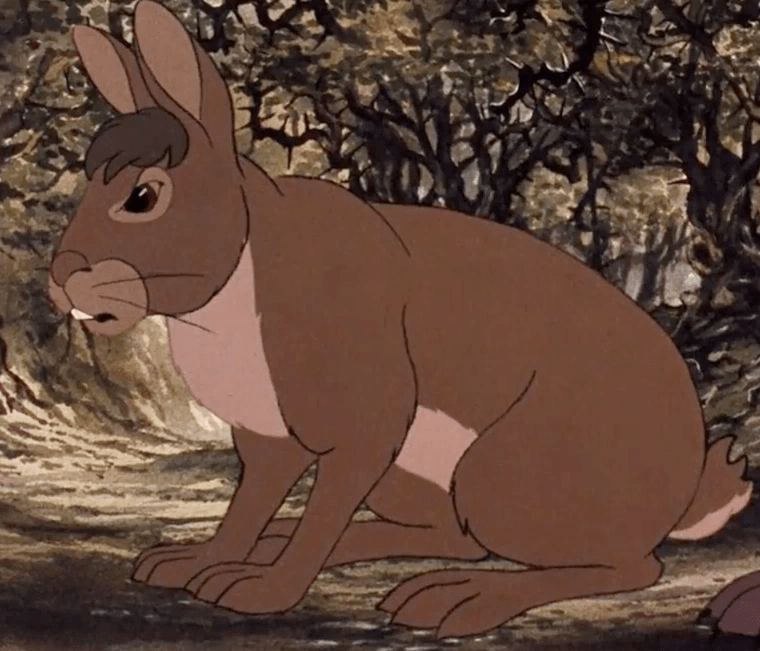
Later in the novel, after Hazel’s party establishes a home, they run into trouble from a nearby warren of militant, even quasi-fascist rabbits, Efrafa. The Efrafans are led by the cunning and terrifying General Woundwort. The General is a beast of a rabbit. Bigwig has, by this time has pulled off a number of impressive feats of his own, but when one of the other rabbits gets a glimpse of Woundwort, they report back that they doubt if even Bigwig would be a match for him.
Bigwig eventually infiltrates Efrafa and succeeds in helping a group escape from the clutches of the General, but Woundwort tracks all of them back to their home on Watership Down.
The Efrafans launch an offensive on Hazel’s warren, one that our heroes are unlikely to survive, except for a desperate plan hatched by Hazel. After they have blocked most of the entrances against the intruders, Hazel leaves through a secret exit, telling Bigwig that he must defend the run (a tunnel within a rabbit warren) that leads to the rest of the rabbits, one of whom has just delivered babies who will surely be eaten if they are captured.
The general leads the assault himself, and he is a terrifying adversary. Deadly. Powerful. Cunning. Fearless. Richard Adams does an excellent job of humanizing his villain. In the book, he devotes a good chunk of the text to exploring Woundwort’s backstory, showing exactly what kind of life could produce such a formidable opponent. He’s no cartoon character (I mean…except for that he literally is). You never despise Woundwort, even if you want him to get his ass kicked.
He and Bigwig eventually meet in a tunnel where there is only room for single combat, and Bigwig fights Woundwort to a standstill. Eventually, both are exhausted, but Woundwort still has time on his side. He gives Bigwig one final offer: give up and save his life, become a servant of Efrafa.

And Bigwig, bleeding and utterly exhausted replies, “My Chief told me to defend this run, and until he says otherwise, I’m staying here.”
It’s a moment that gets me all blubbery and bleary-eyed whenever I think of it, mostly because of the general’s reaction.
“Your chief!” He gasps. This entire time he and all the other Efrafans had assumed that Bigwig was the chief simply because he was the biggest. As soon as Bigwig makes this statement, he doesn’t even know it, but he strikes fear into the hearts of the General and all of his soldiers as they consider the prospect of fighting an even more formidable threat than Bigwig. Unknown to them, Bigwig’s chief rabbit is smaller and weaker and walks with a limp. Hazel probably could not stand up to the General for even a minute, but he is a true leader.
But Bigwig isn’t thinking about any of this. He’s just declaring his loyalty, his willingness to sacrifice everything for the one he follows.
I get the same vibes from Boromir’s “my brother, my captain, my king” line at the end of the first LOTR film.
Scenes like these show what is possible when men trust each other, even with their lives.
I won’t spoil anymore of the story. If you haven’t read the book or seen the movie, I recommend both because both have certain strengths over the other. The book becomes occasionally a little…uh…fucking insufferable with its descriptions of landscapes and flora. Richard Adams clearly held a deep love for the English countryside and that’s cool, but c’mon man…And the movie is pretty badly animated and sort of nuts in places, but undeniably charming. I haven’t seen the more recent Netflix adaptation, and my gut says to avoid it. (Here’s someone confirming what my gut told me and for reasons that my gut is very sympathetic to.)
Having recently read the book with my wife, I can comfortably say that Bigwig is my favorite character. And not in the sense that I identify with him most strongly and so favor him. I’m no Bigwig or Hazel either. I most identify with Fiver, the diminutive, nerve-addled mystic, prone to fearful visions and revelations, sensitive to all manner of deception. And what I love about this book is the way that it makes way for so many imaginable types, each with their unique gifts and weaknesses. Paradoxically, this appreciation for each of their individual talents appears to be wrapped up in Hazel’s leadership, suggesting that it is only when sublimated towards some higher end that our individual gifts can truly come into focus as something worthy of appreciation.
This possibility has become extremely fraught in recent years. Often, in our language about rights and individuality and liberty, the idea of sublimating one’s own will to someone else’s, of being a follower, is treated as if it were itself a sign of some type of moral failure or defect of personality. We have gotten drunk on Emerson’s “Self-Reliance” (whether any particular person has read it or not) and the result has been a nation of self-obsessed assholes, and the consequence is basically that collective action has become much more difficult and outcomes are in general worse for everyone. The second-order effects of this are visible basically everywhere. In Lasch’s The Culture of Narcissism, which I reference frequently, he discusses how modern people are not even capable of honest emulation of admirable personality traits because the implication that they are not good enough (or else why would you need to change?) presents an ego threat. How much harder is it then to pledge oneself to a leader in the same way that these characters do, to say that your will is inferior to theirs and so must be lead?
But such arrogance is only possible in the fluffy, consumerist, ego-insane Nerf world of modernity, one which may be coming to a rapid end. And I think that as the arrogance and narcissism of youth fades, as we begin to realize that we were never kings and that the ego is plant that bears less fruit the more you tend to it, there some part of the soul that begins to long for something like a king.
In my own life, I’ve experienced many bosses, of varying degrees of pettiness and incompetence, but precious few captains or kings. And it’s in moments like those mentioned that I feel this lack most acutely. And for just an instant, in Bigwig’s response to Woundwort, you can glimpse an alternative. It’s my belief that if there is a human future worth having (a debatable question in itself if you’ve been keeping up with the world), then it belongs to those who can harness this magic: brothers, captains, and kings.

 The Barking Years
Leave a comment