
Some thoughts from another alcoholic
Hi. My name is [ ] , and I’m an alcoholic. As of today’s writing, I haven’t had a drink in 4,822 days. That’s about 13 years, if you were wondering.
It’s been a while since I hit up a meeting (they’re pretty difficult to get to where I live currently), but there were years when I went five or more times a week consistently.
For a good chunk of my first year sober, I worked 3rd shift on the line of a plastics injection-molding factory and my weekday schedule looked something like this:
- 6pm — wake up, eat breakfast, get ready for the day
- 8 pm — AA meeting
- 9:30 pm — head to Starbucks and read/write until my shift at the plastics factory
- 11 pm — work
- 7 am — done with work, go workout at the YMCA
- 8:30 am — second breakfast
- 10 am — (ideally) sleep
I probably averaged around six meetings a week during that period. I was That Kind of Alcoholic™ that needed to be kept extremely busy. So AA became part of my routine and my home group became my family. That was a long time ago now. Over the years, life happened. We drifted apart. Sometimes we fell out. Sometimes they relapsed and disappeared only to show up years later in a Soft White Underbelly video claiming they were now the opposite sex (yeah, this really happened). And eventually, my meeting attendance dwindled down to nothing, where it has stayed for about ten years now. But in all that time, I still have not found it necessary to pick up a bottle, in large part because of things that I got from that program.
Before I go on, I’ll admit that there are plenty of things about AA that will annoy the hell out of any sane person who sets foot there. Here are just a few off the top of my head.
- The AA-isms. Endless mantras and thought-terminating bromides from “one day at a time” to “stinking thinking gets me drinking” and everything in between. No matter what your personal situation is, no matter how complex or multi-faceted the problems facing you are, be assured that AA has the answer and that answer can be expressed in ten words or less.
- The bullshit. This too is practically endless because alcoholics are bullshit factories. Actually, that’s a large part of the reason for #1. One thing that you learn in sobriety is that whenever an alcoholic early in recover speaks, there is an approximately 100% chance that everything they are saying is horseshit. Either it’s a lie or it’s insane. Frequently, it’s an insane lie. So it’s kind of good to have a collection stock phrases designed to make them shut the fuck up. Ideally, the recovering alcoholic gets to the point where they can tell themselves to shut the fuck up. In the rooms, we call that “wisdom.”
- The revolving door. Most of the people that you meet, you’re not going to know them in a year. People come in, stay for a bit, get annoyed, get willful, get drunk. And then you don’t see them again, or maybe you do a year or two later and they look like they’ve aged ten years in that time.
- The old-timers. These guys are, yes, founts of wisdom in many ways, but in a lot of other ways, they are just assholes. And no matter how you come to feel about them in the end, there are going to be times when you want to tackle them to the ground and jam your thumbs into their eye-sockets while whispering “It works if you work it” over and over again, which they probably wouldn’t really be able to hear over the sound of their own choking and screaming so the joke wouldn’t really land, but whatever.
- The coffee sucks.
Still, regardless of whatever flaws AA has, I am eternally indebted to it. I can say with absolute certainty that I would not be sober (or even alive) today without it.
So I was pretty fucking pissed slightly miffed when I read the recent viral article “I Don’t See Very Many Black People in AA Meetings and Now I Know Why” in which author Jason Williams complains that Alcoholics Anonymous is racist (or something like that).
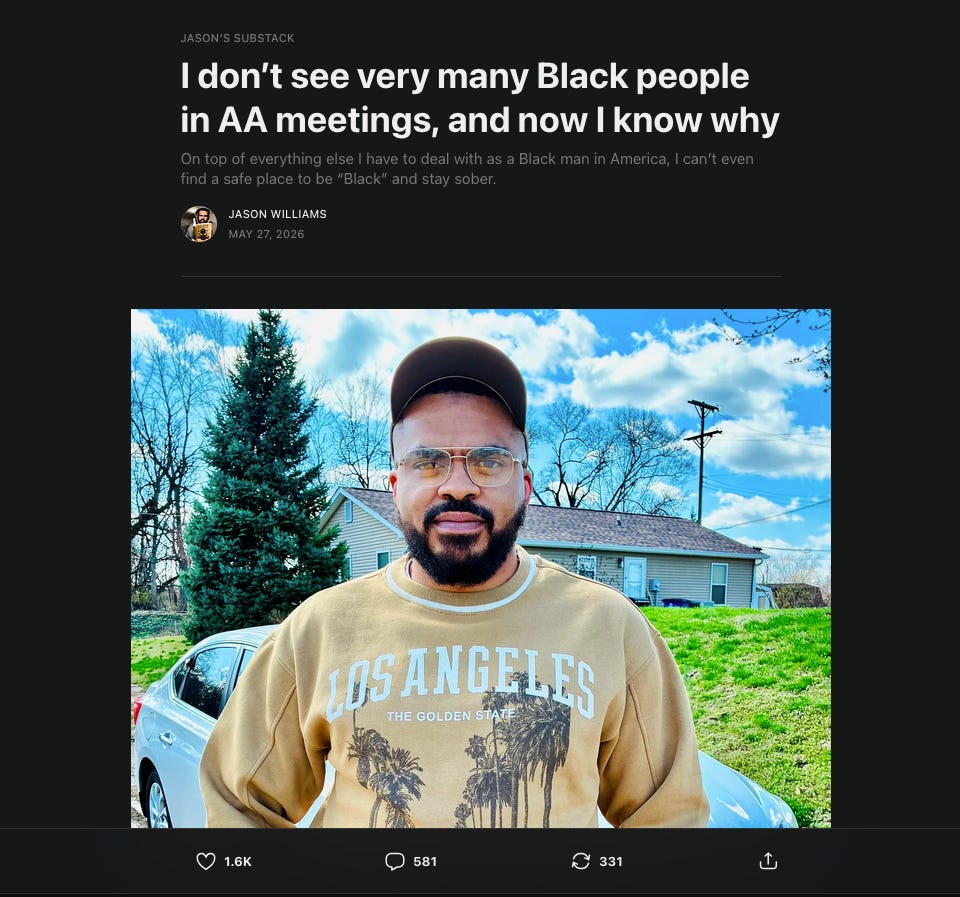
But I thought I’d take a beat to go through some of his complaints and run a little bit of defense for an organization that saved my life. But before I get into nitty-gritty, I want to say that I hope Mr. Williams does manage to remain sober and congratulate him on the time that he’s gotten so far. Getting past the 3 month mark is huge. Sincerely.
The Racist Foundations of Alcoholics Anonymous
Williams spends a good deal of time complaining about the “racist foundations” of AA, but when you boil it down, it’s mostly just vibes type shit. Here, I’ll show you.
Then the more I stopped going to the meetings, the more I researched the history of racism in the foundations of AA organization. I started to notice how most of the stories in the “Big Book” are about white people. I realized that the organization was founded at a time when segregation was a vivid reality and its foundations mirrored the Jim Crow laws of that era.
Man, that’s crazy. I’ve absorbed a fair amount of AA related materials and never seen or heard anything that would indicate any serious overlap between it and Jim Crow so what earth-shattering truth bomb is this man about lay down on me now?
The entire framework of AA was built through the shared cultural and economic experiences of middle-class white men who, to at least some degree, believed in racism and segregation. They certainly didn’t speak against it in any significant way or make noticeable efforts of inclusion.

…Yeah. I mean…like…yeah. The fuck? I’m sorry but what the fuck were you expecting? AA was founded in Akron, Ohio in 1935. The US was like 90% white in the 1940s. Do want to know how white fucking Ohio was? And yeah, so sorry that they weren’t sufficiently ahead of the historical curve to realize that the primary function of this little group they were putting together—getting and staying sober—actually needed to be demoted to its secondary function behind being anti-racist enough to make you comfortable a century later.
And I’m serious, that is the way in which the foundations of AA “mirror” those of Jim Crow: they were both made by white people and in both cases, those white people probably did not have 21st-century-approved views on race. There’s literally nothing else.
This is especially interesting because Williams is going to go on to say:
I’ve met many nice and polite people in these groups. Most of the people I’ve come across in these meetings seem to be just average people doing their best to stay sober another day. From the outside, they just look like “good white people” looking for a sense of community with other recovering alcoholics and addicts. That by itself is not the problem…
The fact that there are quotation marks around “good white people” is a little troubling as is the suspicion implied by “from the outside” and the implication that white people looking for community might only be a component of “the problem” but let’s just ignore all of that in the service of time.
The problem is the failure to acknowledge the racist foundations of the organization that are embedded in the literature and core principles of the program.
Pardon? Q.E.D., motherfucker! Where the fuck are they?¹ Where are these racist foundations?
Racism isn’t always violent, or loud. Sometimes racism appears nice, and polite. Sometimes racism isn’t about what is said, but rather what is not said…The problem is the silence surrounding how systemic racism, institutional oppression, economic disenfranchisement, and generational trauma can impact an individual’s life or substance abuse patterns.
Ohhhhh. OK. Now I get it. The foundations of AA are “racist” because they weren’t already anti-racist. Bill W. and Dr. Bob made the classic error of thinking that they could have a mission that wasn’t about race and therefore assumed neutrality on the subject, but ya can’t be neutral on a moving train losers!!
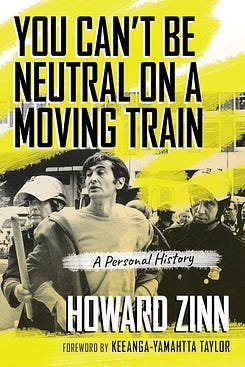
Sure, the 10th of the 12 AA Traditions published in 1946 specifically addresses this:
Alcoholics Anonymous has no opinion on outside issues; hence, the AA name ought never be drawn into public controversy.
But that’s just because they didn’t have the foresight to understand that some 80 years later, not having an opinion on race politics simply wouldn’t be on the table. Anyway, AA is “racist” because it professed to be uninterested in the topic of race and only wanted to be about recovery from alcoholism. Got it. Let’s proceed.
So now as a Black man in these white dominated spaces it was confusing to hear people within the AA groups frequently emphasize personal accountability and “admitting wrongs”, yet completely avoid acknowledging how systemic racism, economic disenfranchisement, or generational trauma can impact an individual’s life or substance abuse patterns.
I’m not sure why you would find this confusing; those things are totally unrelated so there’s no contradi—oh wait, did you mean that you wanted all the white people in the room to take personal accountability for slavery/institutional racism/et al or admit to the wrong-doing of believing they could join a support group that was just about staying sober instead of being anti-racist? What would have been next? Were you going to suggest that maybe whatever got picked up in the donations basket at the end ought to come back to you as “reparations”?
Seriously though, this is pretty dumb. Williams’ problem throughout the article is that the core assumption of radical responsibility that lies at the center of AA conflicts with his progressive anti-racist brainwashing. Developing that sense of ownership over your actions is the point of the infamous 4th Step. Usually, your sponsor will insist that you make a list of every person or thing that you think has wronged you, and then, for each, explain what your contribution to that situation was. In all cases, if you say that you were blameless, your sponsor is going to tell you to do it again.
But Williams has gotten so used to thinking that every problem in his life can be blamed on systemic racism and white people that when provided with a philosophy that says “At least when it comes to drugs or alcohol, everything rests on me. No matter what happens, the decision to use again will be mine. I am absolutely responsible for that decision,” his brain glitches.
I could feel this disconnecting void expand as I find myself wanting to talk about how the crushing weight of systemic racism and institutional oppression has impacted my inability to stay sober, meanwhile everything about these groups and its core literature pretended it didn’t exist.
The realities and psychological consequences of racism, for the victims of racism nor the racists themselves, were never mentioned in any way, shape, or form.
Are you mad that AA doesn’t have some special racial carve-out for you?
If you’re white you need to take ownership, but if you’re a minority you can just blame your drinking on white people. I’m sure that will help you stay sober.
All of this would be more or less forgivable though because any recovering alcoholic has seen it a million times and probably a third of those were in the mirror. Minus the woke trappings, Williams’s article very much falls into the mold of newcomer bullshit.
Newcomer Bullshit
The thing that makes Williams’s essay such a cliche is that, when divorced from the racial complaint, this is just another case of a newcomer entering into the rooms and immediately deciding that they, the person who has so successfully fucked up their life that they NEED to be here thinks that they ought to be calling the shots. Holy shit is this a cliche.
For all their faults, the best thing about old-timers is that they are the first people to let this kind of newcomer know in no uncertain terms that there is not a single person on the face of this earth that needs their advice or wants to hear their bullshit.
Beyond that though, it also smacks of a very old trend of progressives entering organizations or groups and summarily deciding that the problem with that group is that they aren’t running it or that it isn’t dedicated to the thing that THEY want it to be about it. Williams’s chief objection to AA boils down to the fact that it was a group about helping people to get and stay sober, not deconstructing and dismantling whiteness or whatever.
Furthermore, the story of recovery is defined by relapse. On a long enough timeline, relapse happens to everyone. But alcoholics have this interesting quality in that they will, prior to actually relapsing, create set conditions under which they will give themselves permission to drink, and the go about crafting a narrative, the goal of which is to get them to that point while maintaining the illusion of their blamelessness.
Example: Joe is an alcoholic early in recover. The part of his brain that is able to make executive decisions and can recognize the impact of his addiction does not want to drink, but the part of his brain that’s been broken by that addiction and now craves the substance needs him to drink. Unknown to Joe’s conscious mind, these parts have created a compromise such that it would be ok to drink under certain conditions. Let’s say those conditions are:
- Joe’s marriage is in trouble
- Joe was homeless
- Joe couldn’t reach his sponsor
Now that the conditions have been established, that addicted part of his brain is going set all of its cunning into Game of Thrones-style creating those conditions. So one day when Joe has been sober for about six months, he—for no reason that he can discern—starts a fight with his wife and keeps escalating it until she kicks him out of the house. Afterwards, he tries to call his sponsor, but his phone is out of battery; looks like he “forgot” to charge it. Feeling dejected and hopeless, but also—for no reason that he can discern—slightly excited, he makes his way to the liquor store.
In the moment, Joe will narrate this as a story about him being victimized by outside forces, but the clever observer will see through this narrative and realize that Joe was at every moment, enacting his own will and then projecting those choices onto other people and circumstances.
Understanding this was a game-changer for my own ability to stay sober, and armed with that understanding, it’s easy to see how certain details from Williams’s piece line up with the narrative of a relapse, especially his using the “racism” of AA as his excuse to stop going to meetings. But I’m willing to bet that effectively no one in a position to actually impact him is going to be willing to say this, and even if they were, there is an army of people who will be more than happy to cosign his bullshit so he doesn’t need to listen to anyone trying to give him the truth. Williams’s already tough job of maintaining his sobriety is made more complicated because our culture is only too happy to supply him with the exact opposite of what he needs: excuses.
But it gets worse
All of the things mentioned up to this point make Williams look like an asshole, but in totally forgivable and sympathetic ways. You’re an alcoholic; of course you’re an asshole. I’m an asshole too. It’s fine. You’re in AA to work on that.
But this is where we get to the stuff that kind of pushes Williams past asshole on the inverted moral hierarchy and into POS territory. The first of which is his treatment of the longstanding cornerstone of AA: the principle of anonymity.
Then there’s the problem with anonymity.
According to AA’s Tradition 11, “Our public relations policy is based on attraction rather than promotion; we need always maintain personal anonymity at the level of press, radio, and films.“
I understand the surface level of this tradition; it protects the organization from massive egos, public controversy, and people taking credit or ownership of the program.
However, anonymity breeds unaccountability.
It’s a little weird that Williams claims to have been going to these meetings for so long, but is so clearly clueless about something as fundamental as the purpose of anonymity in an organization called Alcoholics Anonymous. No, the point of anonymity isn’t to protect the organization. It was to protect the individual members. At least in the groups that I’ve been to, every meeting ends with a series of chants, one of which goes:
Who you see here
And what you hear here
Let it stay here
Part of the reason why it works is that AA gives people a place to safely speak about the darkest and most painful corners of their lives and know that that information won’t be used against them. Radical change requires radical honesty, and radical honesty requires radical acceptance. This was actually the same conclusion come to by humanistic psychologist Carl Rogers. And the point of anonymity is that it creates a space where that honesty is possible.
All of which makes it pretty ironic when Williams complains that he doesn’t feel “safe” inside of AA meetings for totally bullshit reasons…
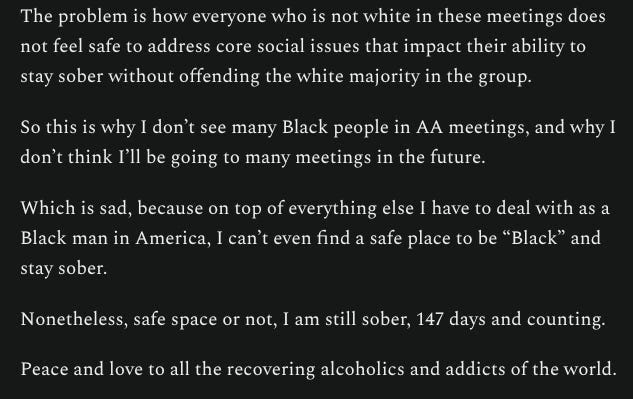
…while threatening the safety of all the people who benefit from this organization in very real, not-bullshit ways.
When an organization like this operates completely behind closed doors and avoids public or media exposure it creates a massive shield. It absolutely smothers the possibility of institutional accountability. It creates a space where people can be mistreated, ignored, or excluded without any possibility of justice. It makes an environment where a cult mentality can grow and feel empowered to do whatever its members please without consequences.
For the uninitiated, what he’s actually talking about here beneath these fluffy phrases like “institutional accountability” and “possibility of justice” is litigation. If you want to know how Woke got so far so fast in our culture, it’s because civil rights law made it possible for plaintiff’s to win MASSIVE payouts by launching civil suits against organizations and companies with even the flimsiest of pretenses².
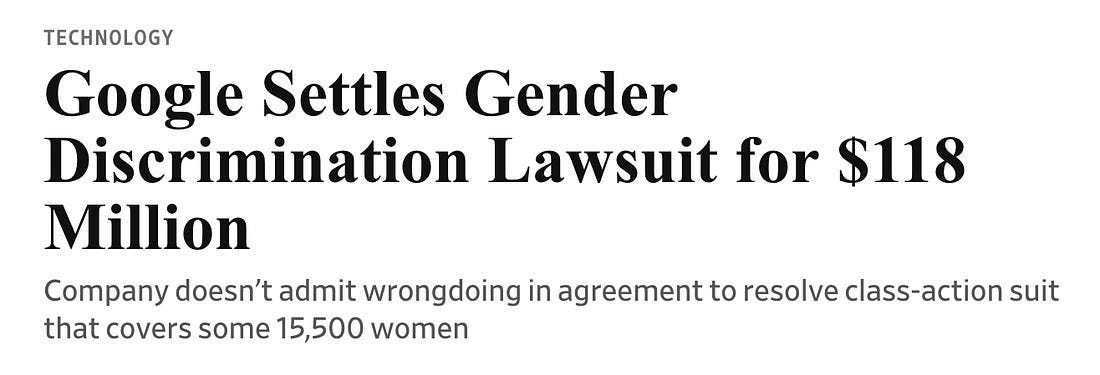
Firms began leaning into Woke and adopting DEI policies in large part to proactively protect themselves from these lawsuits. Here Williams is essentially whining that because AA has basically no organizational structure, it can’t be attacked and/or bankrupted through these kinds of legal attacks.
So although I will not at this time mention names or specific locations out of respect for the surface level value of the anonymity statement, I feel obligated in my spirit to call out the infrastructure of racism embedded within an organization that so many people go to in their time of desperation and need for help.
There’s no central authority in AA, and so there is no such thing as a universal ban from AA as a whole, however, it is not unheard of for specific meeting groups to ban certain individuals, and think that even flirting with this kind of breach of anonymity could be grounds for a ban of that type.
Conclusion
I don’t often find myself using words like “reprehensible” or “disgusting” or “despicable.” I find them to be little to overwrought associate them with low-T pearl-clutchers. But I think I have to make an exception in this case because I truly do find what Williams has done to be pretty vile. The first of the aforementioned 12 AA Traditions reads as follows:
Our common welfare should come first; personal recovery depends upon AA unity.
And Williams decided to spit on that in the most self-centered way possible. Not only did he demonstrate astonishing arrogance in presuming that this program that has helped millions to recover from alcoholism ought to change to suit him, he was apparently willing to sacrifice its utility for the people who actually do use and rely on it. He came into a space that wasn’t his and said, “I don’t care what this is doing for other people. It isn’t catering to me and that’s a fucking problem.”
None of this makes Jason irredeemable, but it is extremely shitty behavior and the fact that he seems to be blocking anyone who criticizes him or otherwise responding in the most fragile, cry-bully bullshit ways possible isn’t a good sign.
[That my original article on this topic published on Substack was mysteriously memory-holed, presumably based on abuse of the reporting system doesn’t help either.]
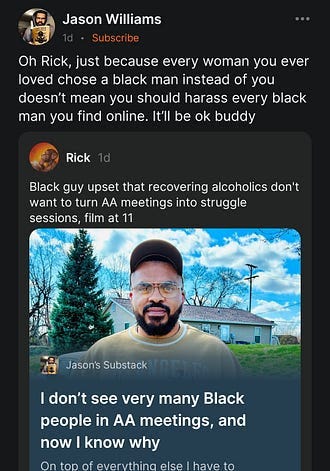
I’m sure that a lot of the commentary that he’s gotten is pretty racist, and that’s not cool. But you kind of encourage that when you shut down actual legitimate criticism by calling it racist. Once you’ve sufficiently degraded any common moral language that could resolve interracial controversies, then pointing to the racial difference is all that’s left.
There’s this scene from the 1999 film Dogma in which Chris Rock plays a forgotten apostle of Jesus Christ, and he explains that Jesus was black, but white people just couldn’t stand getting the gift of free love and salvation from a black man, so they had to make him Jewish (or something; that movie is like the quintessential millennial shitlib take on religion so of course it’s kind of retarded).

But I can’t help but notice something similar going on here with Williams and AA. For all its faults, AA is a vehicle for the transmission of some powerful spiritual lessons that have helped millions of people overcome their addictions and regain control of their lives, but it seems like Jason just can’t handle the fact that these good things are coming a some old white guys, he can’t handle it. And as Rock says,
“That, my friends, is called hypocrisy.”
Thanks for reading The Barking Years! If you’d like to support my work, consider getting a free email subscription.
1
Was it supposed to be this?
In the earlier years of the organization Black people were often excluded from attending the meetings for fear of their negro presence alone triggering white people back into alcoholism and addiction, then when some were allowed, they were forced to sit in the back quietly and not permitted to engage in the conversations. In many cases, they weren’t even allowed to drink the “community coffee”.
Yeah, so sorry but I’m going to need some citations for this one, champ. It’s not that I can’t believe things like this could have occurred, but the idea that they were common enough that they could be considered representative of the organization as a whole let alone to the degree that it could be called a “racist foundation” requiring some kind of “acknowledgement”…like I said, I’m gonna need some evidence on that one, pal.
2
For more on how this works, I recommend Richard Hanania’s The Origins of Woke (2023) as a primer, and Christopher Caldwell’s The Age of Entitlement (2020) as the definitive account of how activists and activist judges have through aggressive misinterpretation of the Civil Rights Act of 1964 created the legal environment in which civil suits deriving from accusations of racism/sexism/etc. could be used to bully even large companies for things like not having enough female managers.
 The Barking Years
Leave a comment